There are many online business ideas to choose from.
You may see people selling products, offering services, teaching online, making videos, or building websites. You may also hear that one type of business is easier or more profitable than another.
That can make choosing your first online business feel harder than it needs to be.
A better place to start is not with the biggest income claim. Start by looking at what fits your skills, money, time, equipment, and the people you want to serve.
Quick Answer
The best online business is not simply the one with the biggest income claim. It is one that fits your skills, starting money, available time, equipment, and the way you can reach customers.
It should also solve a real problem for real people.
Most beginner online businesses fit into a few main groups. These include service businesses, selling products online, digital products, content businesses, and teaching or advising people.
Compare the groups carefully. Narrow your choice to one or two that fit your situation. Then test the idea that appears to fit you better before you spend heavily.
Why Choosing the Right Online Business Matters
A business idea may sound good and still be a poor fit for you.
One business may need equipment you do not have. Another may require more money than you can safely spend.
Some businesses depend on working directly with clients. Others take longer because you first need to build a group of people who regularly follow your work.
A poor fit can waste money and months of effort.
This does not mean you must find a perfect idea before you start. You only need to narrow your choices enough to make a sensible first decision.
What Counts as an Online Business?
An online business uses the internet as an important part of finding customers, selling something, delivering something, or serving customers.
The business may sell a product, provide a service, teach people, or create useful information.
An online business is different from simply having a job.
With a job, an employer normally pays you to do work for the organization. With your own business, you decide what you will offer, who you will serve, and how customers will find you.
It is also different from a hobby.
A hobby may be something you enjoy doing without trying to earn money from it. A business has something clear to sell or provide and a plan for serving people who may be willing to pay for it.
A small gig, or short-term paid job, can sometimes grow into a business.
For example, one freelance project, or one paid job for a client, may lead to a service that you later offer to several clients.
The main point is simple. An online business uses the internet to help you provide something useful to other people in exchange for payment.
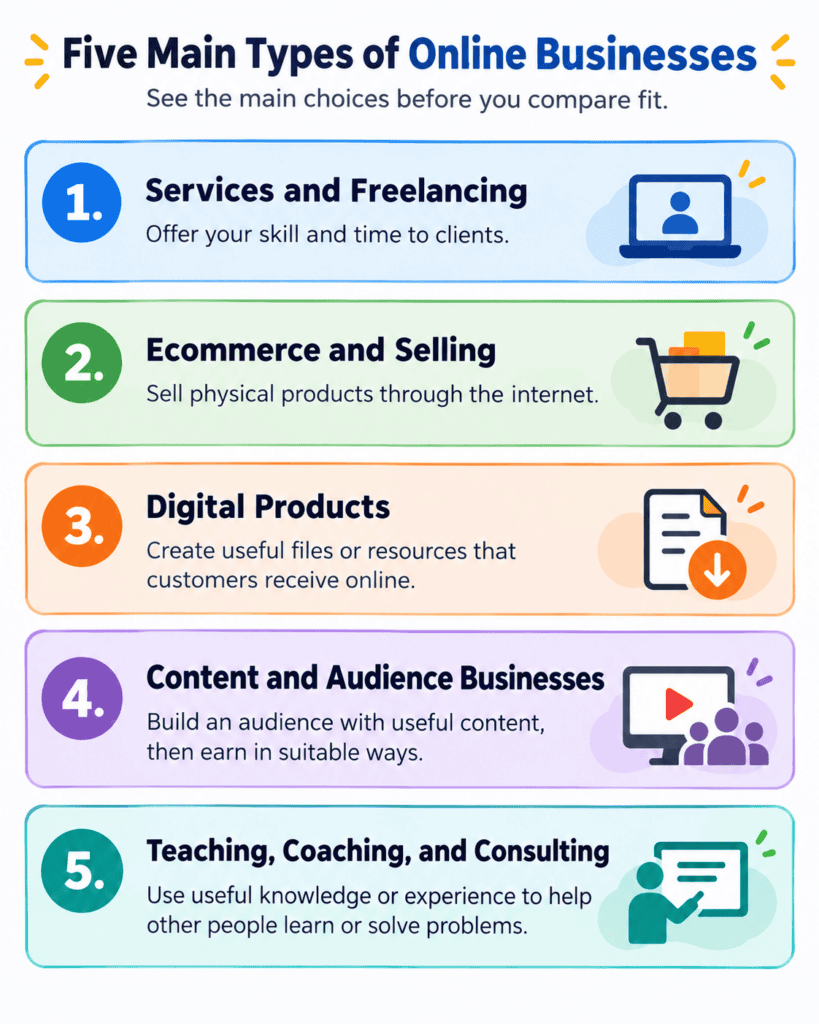
Five Main Types of Online Businesses
You do not need to study fifty or one hundred business ideas before making a decision.
Most beginner ideas fit into a smaller number of business types.
Understanding these main types makes your choices easier to compare.
1. Services and Freelancing
A service business means you do useful work for another person or business.
Examples include writing, bookkeeping, graphic design, virtual assistance, translation, editing, website work, or social media support.
In freelancing, the customer is usually called a client. A client is a person or business that pays you to provide a service.
Service businesses may suit people who already have a useful skill or are willing to learn one.
They may also suit beginners who want to start without buying a large amount of products or equipment.
You still need a way to find clients. You also need enough time to complete the work you promise.
2. Ecommerce and Selling
Ecommerce simply means selling products through the internet.
The products may be physical items that are delivered to customers.
You may sell through your own online store, an online marketplace, social media, or another website or service that helps people buy and sell. Such a website or service is often called a platform.
This model may suit people who enjoy products, selling, customer service, and managing orders.
Selling physical products can involve more steps than some other business models.
You may need to think about where the products come from and where you will keep them. You may also need to plan delivery, returns, and customer payments.
Some ecommerce businesses need more starting money than a simple service business.
3. Digital Products
A digital product is something a customer receives online or as a file instead of as a physical item.
Examples include templates, printable materials, digital guides, photographs, designs, computer programs, or other useful files and resources.
You normally create the product before selling it.
One benefit is that you may be able to sell the same digital product more than once without making a new physical copy each time.
But creating the product is only part of the work.
People still need a reason to want it. You also need a way to reach the people who may need it.
4. Content and Audience Businesses
A content business grows by creating useful or interesting information for a group of people.
The content may be on a website, YouTube channel, podcast, email list, social platform, or another channel.
The people who regularly read, watch, or listen to your content are called your audience.
A content business may later earn money in several ways.
For example, it may earn from advertising, products, or services. A company may also pay to sponsor suitable content. The business may also use affiliate marketing.
Affiliate marketing is an arrangement in which a company may pay you when someone you refer completes a required action, such as buying a product.
Building an audience usually takes time.
This model may suit someone who enjoys teaching, explaining, writing, speaking, showing how something works, or creating useful information regularly.
It may be a poor fit for someone who needs customers quickly and does not want to spend time building an audience.
5. Teaching, Coaching, and Consulting
Some businesses earn money by helping people learn, improve, or solve a problem.
Teaching usually focuses on helping someone learn a subject or skill.
Coaching usually means helping someone work toward a goal.
Consulting usually means using your knowledge or experience to advise a person or business about a problem or decision.
These businesses may use video calls, online classes, written materials, group programs, or other methods.
They usually work best when you have knowledge or skills that are useful to other people. You also need to be honest about what you know and what you are qualified to teach.
Use the Fit Check Before You Choose
Knowing the main types of online businesses is only the beginning.
Now compare them with your own situation.
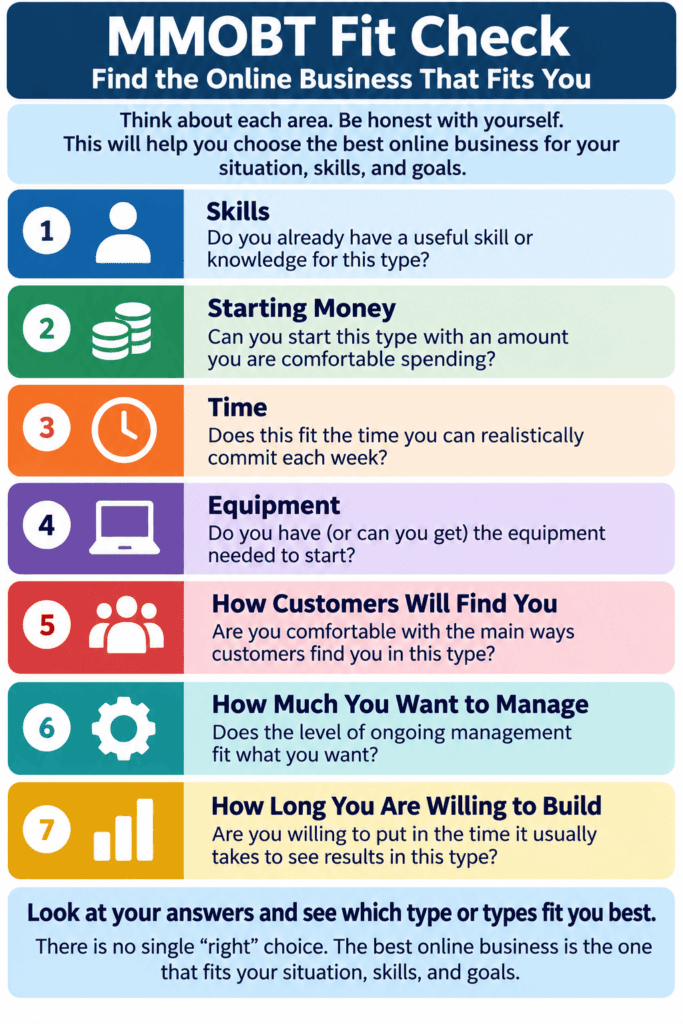
The MakeMoneyOnlineBestTools.com (MMOBT) Fit Check looks at seven areas:
- skills
- starting money
- time
- equipment
- how customers will find you
- how much you need to manage
- how long you are willing to build
You do not need the highest score in every area.
The purpose is to see which business models fit you better and which ones may create unnecessary problems.
Skills
Start by asking what you already know how to do.
You may have work skills, business skills, teaching skills, practical skills, creative skills, or knowledge from your life experience.
Do not assume you have no useful skills just because you are new to online business.
At the same time, be realistic.
If a business depends on a skill you do not yet have, ask whether you are willing and able to learn it.
Starting Money
Ask how much money you can safely use to begin.
This does not mean how much money you could borrow or how much you hope to earn later.
It means how much you can afford to use without putting important needs at risk.
Some online businesses can begin with very little money. Others may need products, computer programs, equipment, advertising, or paid expert help.
Low-cost does not always mean no-cost.
Time
Think about how much time you can regularly give to the business.
A person with ten hours a week may need a different model from someone who can work full time.
Also think about when you are available.
A service that requires live meetings may be difficult if your available time does not match your clients’ schedules.
A business that lets you work at times that suit you may fit better.
Equipment
Look at what you already have.
Do you have a laptop?
Do you mainly use a phone?
Do you need a camera, microphone, printer, special computer programs, or reliable internet?
Do not buy equipment simply because someone says you need it.
First decide whether the business truly requires it.
How Customers Will Find You
Think about how the people who may buy from you will find you.
This is one of the most important parts of choosing a business.
A freelancer may look for clients directly.
An ecommerce seller may reach people through an online marketplace, store, social media, or advertising.
A content business may first attract people through useful articles, videos, or other content.
Ask yourself:
How will the people who need this offer find me?
If you do not have a good answer yet, that does not automatically mean the idea is bad.
It means you need to think about this before spending heavily.
How Much You Want to Manage
Some business models are simpler to begin but give you less control.
Others give you more control but require you to manage more things yourself.
For example, using a large selling platform may make it easier to reach customers. However, you must follow that platform’s rules.
Running more parts of the business yourself may give you more control. It may also create more work.
Ask yourself how much you want to manage as a beginner.
How Long You Are Willing to Build
Think about how long you are prepared to learn, test, improve, and keep working while the business develops.
There is no honest way to promise exactly when a new business will become profitable.
Different business models grow in different ways.
Some service businesses may allow you to begin looking for clients soon after you are ready to provide the service.
A content business may take longer because you need time to create useful content and build an audience.
Think about how long you are willing to keep learning, testing, and building before expecting the business to become established.
Compare the Five Main Types of Online Businesses
There is no single winner.
The better choice depends on the beginner.
Here is a simple comparison.
| Business Type | Starting Money | Main Beginner Challenge |
| Services and Freelancing | Often lower | Finding clients and doing good work |
| Ecommerce and Selling | Can be higher | Products, orders, delivery, and customer service |
| Digital Products | Often low to moderate | Creating something people truly want |
| Content and Audience Businesses | Often lower at the beginning | Building an audience takes time |
| Teaching, Coaching, and Consulting | Often lower | Building trust and showing that your help is useful |
Use this comparison as a starting point, not as a fixed rule.
One service business may need expensive equipment. Another may need almost none.
One ecommerce business may start small. Another may require a much larger budget.
Use the comparison together with your Fit Check.
Narrow Your Choice to One or Two
Now start removing poor fits.
You do not have to make your final choice immediately.
Begin by asking which models clearly do not fit your present situation.
If you have very little starting money, a business that requires you to buy many products in advance may not be your best first choice.
If you do not want to work directly with clients, freelancing may not fit you.
If you enjoy teaching and have useful knowledge, online teaching may deserve a closer look.
If you enjoy creating useful information and are willing to build slowly, a content business may be worth considering.
Keep removing weak fits until you have one or two choices that make sense.
That is more useful than choosing an idea simply because someone online says it is profitable.
Do Not Spend Heavily Yet
Choosing a business model is not the same as proving that your idea will work.
You still need to find out whether real people have the problem you want to solve. You also need to find out whether enough people are interested in your offer to keep testing it.
This process is called validation.
Validation means testing your idea before spending a large amount of money or time on it.
You may discover that your first idea needs to change.
That is useful information.
It is better to learn this early than after paying for many tools, products, or services.
Your next step is to test the idea before spending heavily.
Two Beginners Can Make Different Good Choices
Two people can use the same Fit Check and choose different business models.
Both choices may be reasonable.
Example 1: A Beginner With a Useful Skill and Very Little Starting Money
Imagine a beginner who is good at proofreading and writing.
She already has a laptop and reliable internet. She has only a small amount of money to start.
She can work several hours each week. She does not want to buy products or manage shipping.
A service business may fit her better than ecommerce.
She could explore proofreading, editing, writing, or another service that uses skills she already has.
Her next challenge would be finding the right clients and testing whether people will pay for the service.
Example 2: A Beginner Who Enjoys Teaching
Now imagine another beginner.
He has several years of experience teaching a subject that people want to learn.
He has a laptop, reliable internet, and time in the evenings.
He enjoys explaining things and working directly with people.
Teaching or tutoring online may fit him better than selling physical products.
He may not need a large amount of starting money.
However, he still needs to decide whom he wants to teach. He also needs to decide what problem he will help solve and how learners will find him.
Neither beginner chose a business because of an income promise.
Each person looked at fit.
That is the purpose of the MMOBT Fit Check.
Common Mistakes When Choosing an Online Business
Mistake 1: Chasing the Biggest Income Claim
Large income claims can make a business idea look better than it really is.
They do not tell you how much time, skill, money, experience, or luck may have been involved.
They also do not tell you whether the business fits your situation.
Instead of asking, “Which one makes the most money?” start by asking:
Which business can I realistically learn, start, test, and use to serve people?
Mistake 2: Buying Tools Before Choosing the Business
Beginners sometimes buy computer programs, websites, courses, equipment, or subscriptions before they know exactly what business they are building.
This can waste money.
Choose the model first.
Then decide what you truly need.
A tool should solve a real problem in the business. It should not create the business for you.
Mistake 3: Choosing Something Because Other People Are Doing It
A business may be popular and still be a poor fit for you.
Another person may have different skills, more money, better equipment, more time, or an existing audience.
Learn from what other people do. But make your decision based on your own situation and the people you want to serve.
Mistake 4: Thinking Low-Cost Means No-Cost
Some online businesses can begin with little money.
That does not mean there will never be costs.
You may later need computer programs, equipment, payment services, website services, training, advertising, or other support.
The costs depend on the business model.
Do not assume an online business is free simply because it is online.
Practical Action: Complete Your MMOBT Fit Check
Do not try to choose from every online business idea you have seen.
Start with the five main types of online businesses in this article.
Work through these questions:
- What useful skills or knowledge do I already have?
- What am I willing to learn?
- How much money can I safely use to start?
- How much time can I give the business each week?
- What equipment do I already have?
- How would customers find me?
- How much am I ready to manage?
- How long am I prepared to test and build the business?
Remove the models that clearly do not fit.
Then choose one or two that deserve more study.
Do not spend heavily yet.
Your next job is to validate the idea that appears to fit you better.
Key Points to Remember
- There is no single best online business for everyone.
- Choose by fit, not by the biggest income claim.
- Compare your skills, money, time, equipment, how customers will find you, how much you need to manage, and how long you are willing to build.
- Most beginner ideas fit into a small number of main online business types.
- Remove poor fits before trying to choose a winner.
- Low-cost does not always mean no-cost.
- Do not buy tools before you know what you actually need.
- Narrow your choice to one or two ideas.
- Validate the better-fitting idea before you spend heavily.
Your Next Step
Once you have narrowed your choice, the next question is not:
“How much can this business make?”
A more useful question is:
“Do real people have the problem I want to solve, and is there enough interest to keep testing this idea?”
That is where business idea validation begins.