By Daphne Okonkwo
Starting an online business can be confusing when you are new.
You may hear that you need a website, special software, a registered company, or a large amount of money before you can begin.
You may also see people promising that certain online businesses are easy or can quickly produce a large income.
With so much information, it is hard to know what you really need and what should come first.
A good online business starts with something much more basic: people. Think about whom you want to help, what they need, and what useful product or service you could offer them.
This guide will take you through the process one step at a time. You will learn how to choose a suitable type of online business and test your idea before spending heavily.
You will also learn how the money works, what you really need to set up, and how to work toward finding and serving your first paying customer.
There is no guarantee that an online business will make money. But starting in the right order can help you avoid unnecessary spending and make better decisions about your business.
If you are still comparing broader online-income paths, see How to Make Money Online: Honest Options for Beginners.
Quick Answer
To start an online business, first choose a group of people you can help and a problem you can solve with a useful service, product, or other offer.
Then choose a type of online business that fits your skills, time, budget, device, and country.
Before spending heavily, find out whether people are interested in what you plan to offer.
Make a simple plan and set up only what the business really needs. Then begin looking for your first paying customer and serve that customer well.
An online business can take time to become profitable, and no type of online business guarantees income.
Table of Contents
Why This Matters
It is easy to spend money before you have a real business.
A beginner may pay for a website, software, inventory, training, advertising, or other tools before knowing whether people actually want the product or service.
Some of those things may be useful later. The problem is paying for them too soon.
Before spending heavily, know three things first: whom you want to help, what you can offer them, and whether there is real interest in that offer.
Once you understand those things, it becomes easier to decide what the business actually needs.
What an Online Business Really Is
An online business uses the internet to sell products, services, or other things of value to customers.
Customers may find the business online and place an order or make a payment. They may also receive a product or service, or use the internet to contact the business.
For some businesses, almost everything happens online. For others, only part of the work does.
One person might teach students through online tutoring sessions. Another might sell downloadable study materials. Someone else might sell physical products through an online store and ship them to customers.
These businesses work in different ways, but they have something important in common. They serve real people who need or want something useful.
An Online Business Is Different From an Online Job
With an online job, you normally work for an employer. The employer gives you work to do and pays you according to your employment agreement.
Running a business is different. You decide what you will offer and look for customers who may want it. You also manage your costs, receive payments, and provide what you promised.
Freelancing can look similar to a small online business. A freelancer usually sells a skill or service directly to clients. Over time, that work may grow into a larger business.
What you call it is not the most important part. What matters is knowing what useful thing you will provide, who will pay for it, and what you will be responsible for.
From there, the best place to begin is with the people you hope to serve.
Start With People and a Real Problem
A common beginner question is:
What online business should I start?
A better first question is:
Who can I help, and what problem can I help them solve?
Businesses exist because people need or want something.
A parent may need tutoring for a child who is struggling in school. A small business owner may need help creating social media posts.
A busy family may want a product delivered to their home. Someone learning a new skill may need clear teaching.
Each situation begins with a person and a need.
That does not mean every problem will become a successful business. It simply gives you a more useful place to start.
Choose a Group of People You Understand
You do not have to serve everyone.
Think about a group whose needs you already understand or are willing to learn about.
For example:
- Students who need help with a particular subject.
- Small businesses that need a service you can provide.
- Parents looking for useful educational materials.
- People who want to learn a skill you understand.
- Customers looking for a particular type of physical product.
You may hear these people described as your target customers or target market. Both terms refer to the particular group of people your business is trying to help.
Look for a Problem You Can Help Solve
Once you have a group in mind, pay attention to what they need.
What questions do they ask? What do they find difficult or confusing? What takes too much of their time?
What are they already paying someone to do? What products are they already buying to help them?
Then ask:
Can I offer something useful that helps with this problem?
The answer may lead to a service, physical product, digital product, teaching business, or another type of online business.
Try not to choose something only because another person says it can make a lot of money.
For a business to earn money, somebody needs a reason to pay. Usually, that reason is a useful product, service, skill, knowledge, or convenience that the customer wants.
Choose an Online Business Model That Fits You
A business model is simply the way a business provides something useful to customers and makes money.
There are many kinds of online businesses. As a beginner, you do not need to study every possible model.
It is more useful to understand a few common ones and see which may fit your situation.
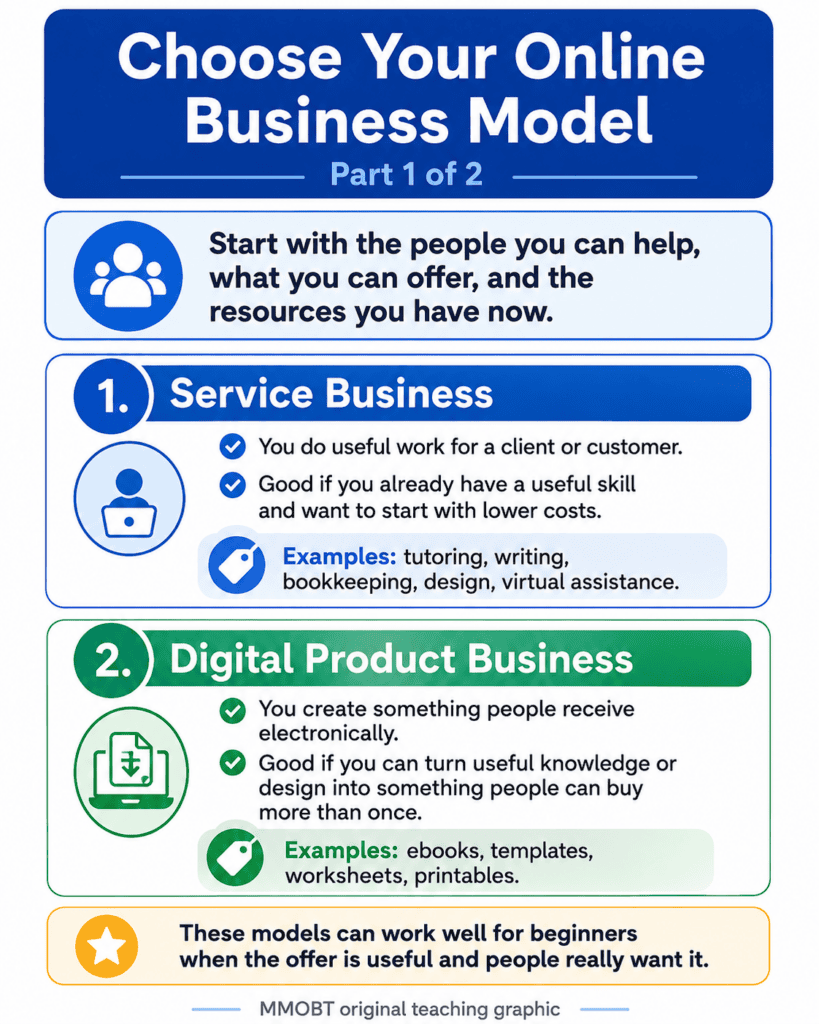
Service Business
A service business earns money by doing useful work for another person or business.
Examples include tutoring, writing, graphic design, bookkeeping, editing, consulting, and virtual assistance.
The customer pays for the work, skill, or knowledge you provide.
This type of business may be a practical starting point if you already have a useful skill and do not have much money to invest.
Digital Product Business
A digital product is something the customer receives electronically instead of as a physical item.
Examples include ebooks, templates, worksheets, printables, and digital designs.
You create the product and then sell it to customers. Unlike many services, you usually do not have to repeat the same work from the beginning for every person who buys.
Still, creating a product does not mean people will automatically want it. You need to understand what they need and how you will reach them.
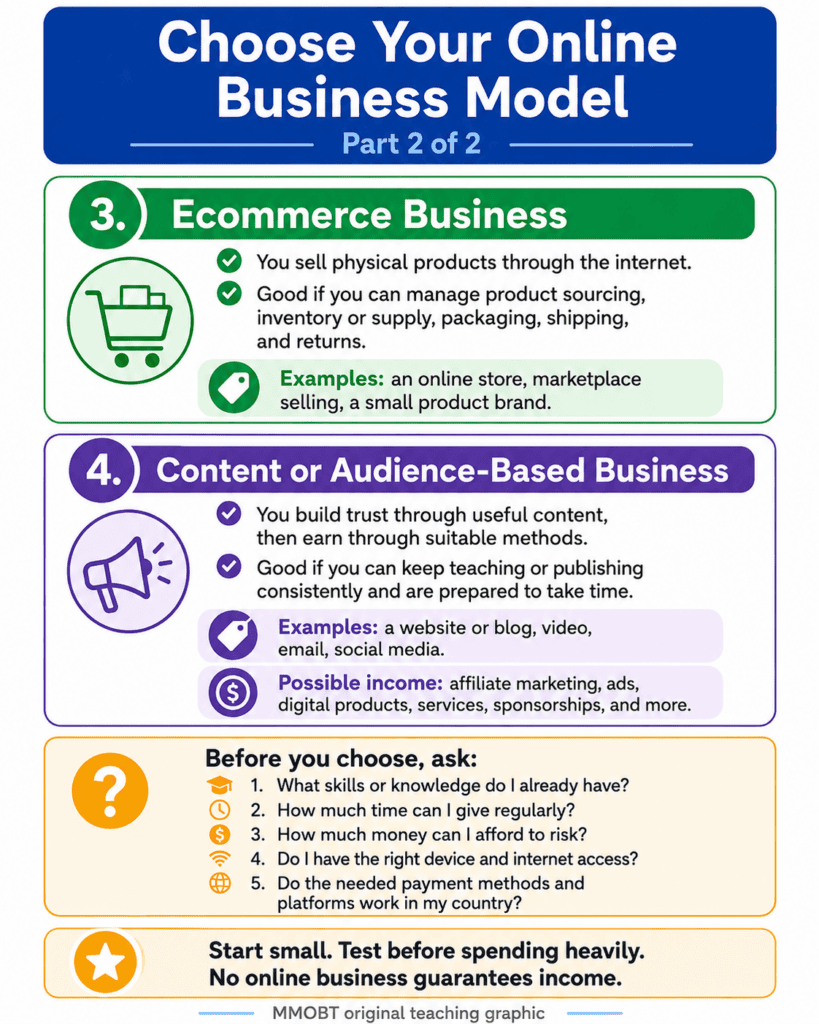
Ecommerce Business
Ecommerce means selling products through the internet.
This often includes physical products sold through an online store or marketplace. A marketplace is a website or platform where different sellers can offer products to customers.
Physical products can bring extra responsibilities. You may need to think about inventory, packaging, shipping, returns, and getting orders to customers.
You may also see the word fulfillment. Fulfillment is the process of preparing an order and making sure it reaches the customer.
Because physical products can require more money at the beginning, testing the idea before buying a large amount of inventory is especially important.
Content or Audience-Based Business
Some businesses first build a group of readers, viewers, or listeners by providing useful content. They may use a website, videos, social media, email, podcasts, or other methods.
Later, the business may earn money through advertising, affiliate marketing, products, services, sponsorships, or another suitable method.
For example, affiliate marketing is a way to earn a commission by introducing people to a product or service that may help them.
If someone takes the required action through your special affiliate link, the company may pay you a commission.
Building an audience usually takes time. It should not be treated as a quick way to make money.
Choose a Model That Fits Your Present Situation
There is no single online business model that is right for everyone.
Think about your own circumstances before choosing one:
- What skills or knowledge do I already have?
- How much time can I regularly give to the business?
- How much money can I afford to risk?
- What device and internet access do I have?
- Would I rather provide a service or sell a product?
- How much business experience do I have?
- What do I hope to build over time?
- Can I use the payment methods and online platforms the business needs in my country?
A person with several thousand dollars available to invest can make different choices from someone who needs to start with very little money.
Technology matters too. A business that requires a lot of computer work may not be a good first choice if you only have a phone.
Start with one model that fits your situation now. Other options can come later as you learn and grow.
Test Your Idea Before You Spend Heavily
Once you have a business idea, it can be tempting to build a website, buy software, order products, or pay for advertising.
First, find out whether real people are interested.
In business, this is often called validation. It means looking for evidence that people have the problem you want to solve and may be interested in what you plan to offer.
Validation cannot prove that a business will succeed.
What it can do is help you answer a useful question:
Is there enough real interest for me to take the next step?
Talk to Possible Customers
Talking with people who may have the problem is one simple way to learn.
Ask what they currently do about it. Find out what is difficult and what they have already tried. Ask what would make a solution useful to them.
At this stage, listening is more important than selling.
If several people describe the same problem, that gives you useful information to work with.
Look at What People Are Already Searching for and Buying
You can also learn by looking at what is already happening in your market.
Study businesses that serve similar customers. Read customer questions and reviews where appropriate. Notice what people like, what they complain about, and what they say is missing.
Finding other businesses in the same area does not automatically mean you should give up. It may be a sign that people are already willing to spend money on that type of help.
Study the market, but do not copy another business. Learn what customers need and then create your own useful offer.
Test a Small Version of Your Offer
Your first test does not have to be large.
For a service business, you might describe one clear service and offer it to a small number of suitable people.
If you are thinking about a digital product, talk with some of the people you hope will use it. You might also show them a simple description, outline, or sample.
Their response can help you see whether the idea addresses a problem they care about.
For a physical product, it may be possible to begin with a small quantity instead of buying a large amount of inventory.
The exact test depends on the business.
The purpose is to learn before making a large commitment.
You may discover that people are interested. You may find that the offer needs to change. Both results are useful because they give you better information before you spend more money.
Make a Simple Plan and Understand How the Money Works
You do not need to begin with a long, complicated business plan.
You do need a clear idea of how the business is supposed to work.
Write down the answers to some basic questions:
- Who is my customer?
- What problem will I help solve?
- What will I sell?
- How will customers find me?
- How will they pay me?
- What will it cost me to provide the product or service?
- What other costs will I have?
- What do I need before I can make my first sale?
Putting these answers on paper can reveal problems that are easy to miss when everything is still in your head.
Know Your Startup Costs
A startup cost is money you spend to start the business.
How much you need depends on the type of business.
A service business may require little beyond equipment and internet access you already have. Another business may need materials, products to sell, a website, software, business registration, insurance, shipping supplies, or other expenses.
Do not assume that every cost mentioned in an online business guide applies to you.
A simple way to look at your expenses is to divide them into two groups:
Needed now: Something you really need before you can operate properly, receive payment, or provide what you promised.
Can wait: Something that may help you later but is not necessary for your first test or first customer.
That distinction can protect you from spending money simply to make a new business look more established.
Understand Revenue, Costs, and Profit
These three words are easy to confuse.
Revenue is the money a business receives from sales before expenses are taken out.
Costs are the expenses involved in starting and running the business.
Profit is the money left after the business costs are subtracted from the revenue.
Suppose a business receives $500 in sales.
The owner did not necessarily make $500 in profit.
There may have been costs for products, shipping, payment fees, advertising, software, or other expenses. Those amounts have to be subtracted.
This is why a large sales figure may sound impressive without telling you how much money the owner actually kept.
Keep simple records of money coming in and money going out from the beginning. If the business grows, you may later need a more detailed system.
Set Up Only What Your Business Actually Needs
After choosing a business model and testing your idea, you can decide what you really need in order to operate.
Beginners often receive confusing advice at this stage.
You may hear that every online business needs a limited liability company (LLC), a website, an Employer Identification Number (EIN), or several types of paid software.
That does not mean all of those things apply to you.
Some requirements depend on the kind of business you are starting. Others depend on where you live and where the business operates.
Check What Business Setup Applies to You
In the United States, the way you set up and register a business can depend on the type of business and where it operates. Licenses, permits, and tax responsibilities can also vary.
A sole proprietorship is a business owned by one person that has not been set up under another business structure.
An LLC, or limited liability company, is a type of legal business structure created under state law.
An LLC is not an automatic first step for every beginner.
Where you live and the kind of work you do can also affect whether you need registrations, licenses, or permits.
Before making legal or tax decisions, check the current rules that apply to your location and situation. General information can help you understand the basics, but it is not a substitute for individual legal or tax advice.
Understand What an EIN Is Before Applying
An EIN, or Employer Identification Number, is a federal tax identification number issued by the Internal Revenue Service for business purposes.
Whether you need one depends on your business situation.
Do not assume that every online business needs an EIN. Whether you need one depends on your business and tax situation.
If you are in the United States, check the current Employer Identification Number (EIN) requirements from the Internal Revenue Service (IRS) before applying.
Decide How Customers Will Pay You
Your business needs a safe and practical way to receive payments.
A payment processor is a service that helps a business accept customer payments and move the money through the payment system.
Your choices may depend on your country, type of business, bank access, currency, customer location, and the platform you use.
Before choosing a payment service, check a few basic things:
- Does it operate in my country?
- Does it allow my type of business?
- How can my customers pay me?
- What fees will I pay?
- How and when will I receive my money?
- What information or documents will I have to provide the payment service?
A payment service that works well for someone else may not be the right one for your business.
Decide Whether You Need a Website Now
A website can be useful, but not every online business needs a full website before testing an idea or finding its first customer.
For some businesses, a website is an important part of how customers find the business, understand the offer, place orders, or receive information.
Others may be able to begin through direct contact, an online marketplace, another platform, or another suitable method.
Before paying for a website, ask:
What do I need this website to do for my business right now?
If the answer is not clear yet, it may be better to understand the business more fully before spending the money.
Keep Basic Business Records
Even a small business should keep records.
At the very least, you should be able to see the money the business receives, and the business expenses you pay.
Depending on your situation, you may also need records of orders, invoices, receipts, refunds, taxes, and other business activities.
Good records help you see whether the business is actually making money. They can also make tax and business reporting easier when those responsibilities apply.
Remember That Country Rules Differ
This article is researched primarily for the United States, but many of the basic business principles can be useful in other countries.
The legal and practical details may be different.
Business rules and costs can vary from one country to another. These may include registration, taxes, licenses, banking, payment services, shipping, privacy rules, identity requirements, and internet costs.
If you live outside the United States, check the rules and services that apply where you live. A USA requirement or payment option may not apply in your country.
Find Your First Paying Customer and Deliver Well
A business can have a good idea, a professional-looking logo, and a beautiful website and still have no customers.
Sooner or later, you need to reach people who may genuinely need what you offer.
Start Where Your Customers Are
Think again about the people you decided to serve.
Where are they likely to look for help?
Depending on the business, possible customers may come through:
- People you already know.
- Professional or community groups.
- Online marketplaces.
- Social media.
- Search engines.
- Local businesses.
- Direct contact with people or businesses that may need your service.
- Helpful content that answers questions your intended customers are already asking.
You do not need to use every method.
Choose one or two that make sense for your business and the people you are trying to reach.
Make Your Offer Easy to Understand
A possible customer should not have to struggle to understand what you are selling.
Be able to explain:
- What are you offering?
- Who is it for?
- What problem does it help solve?
- What will the customer receive?
- What does it cost?
Saying that you provide “online business services,” for example, does not tell a customer very much.
It is more useful to name the particular service and the kind of person or business it is meant to help.
Products need the same clarity. Explain what the customer is buying and what they will receive.
And do not promise a result you cannot guarantee.
Ask for the Sale Without Pressuring the Customer
Selling is part of running a business.
If your offer fits someone’s need, explain it clearly and ask whether the person would like to buy.
There is no need to pressure anyone.
Give the customer enough information to make a sensible decision. Explain important costs and conditions. Mention delivery times, subscriptions, limits, or other commitments when they apply.
If the offer is not suitable for that person, do not force the sale.
A business needs income, but it also needs trust.
Deliver What You Promised
The responsibility does not end when someone pays you.
Provide the product or service you promised.
If you sold a tutoring session, provide the session as agreed. If you sold a digital product, make sure the customer receives it. If you sold a physical product, handle the order and delivery properly.
Problems sometimes happen. When they do, communicate with the customer and handle the problem responsibly.
Learn From Your First Customer
A real customer can teach you things that planning cannot.
After providing the product or service, look back at what happened.
Was anything confusing? Did the work take longer than expected? Did it cost more than you thought it would?
Was the price enough to cover your costs? What questions did the customer ask? What would you do differently next time?
One customer will not tell you everything.
But that first real experience can help you serve the next customer better.
Improve, Protect, and Grow the Business
Once you begin serving customers, you will know more about what works and what needs attention.
There is no need to rush into adding more products, software, advertising, or online platforms.
Start by improving what you already have.
Improve What Customers Find Useful
Pay attention to customer questions, complaints, requests, and buying decisions.
If customers repeatedly value one part of your service, strengthen it.
If several people become confused about the same thing, make it clearer.
If something costs more to provide than you expected, look again at the price or the way you provide it.
Improvement does not always mean getting bigger. Sometimes it simply means doing the present work better.
Protect Customer Trust
Be truthful about what you sell. Keep your promises. Protect customer information. Explain important costs and conditions. When you make a mistake, correct it.
If you recommend a product or service and may receive a commission, make that relationship clear.
In the United States, check the current guidance from the Federal Trade Commission (FTC) on affiliate disclosures.
Do not recommend something simply because it pays you more. The recommendation should also make sense for the person you are trying to help.
Be Careful With Business and Coaching Offers
Beginners often see advertisements for expensive coaching and business offers, ready-made businesses, secret systems, and other offers that promise to make starting a business much easier.
Some paid training may be useful. What matters is understanding what you are buying before you spend the money.
Be especially careful if someone:
- Guarantees that you will make money.
- Pressures you to pay immediately.
- Does not clearly explain how the business makes money.
- Uses other people’s results to suggest that you will get the same results.
- Says most of the work will be done for you while money simply comes in.
- Keeps adding expensive upgrades.
- Makes the refund rules difficult to understand.
Pressure is not a good reason to buy.
Take time to understand the offer and its full cost. Find out what work you will still have to do and how the business is supposed to make money.
Grow When There Is a Reason to Grow
Later, you may decide to improve your website, buy better equipment, add software, advertise, hire help, create another product, or enter another market.
Those things can make sense when they solve a real business problem.
Before spending more money, ask:
What problem will this expense solve?
If you cannot answer that clearly, you may not need the expense yet.
Useful Examples
The following examples are made up to explain the lesson. The people and situations are not real, and they are not income examples.
Maria: A Useful Skill and Very Little Money
Maria knows how to help small businesses organize basic bookkeeping records.
She has a laptop, internet access, and the necessary skill. She does not have much money to invest.
Instead of beginning with a complicated website or several business programs, Maria can first decide what kind of small business she wants to serve.
Then she can describe one clear service and speak with a few suitable business owners. Their answers can help her learn whether the service solves a problem they actually have.
Her first test might be offering that one service to a small number of possible clients.
If she finds real interest, she can decide what additional setup is needed before accepting customers.
David: Knowledge That Could Become a Digital Product
David has spent years helping new gardeners understand how to plan a small vegetable garden.
He thinks some of that knowledge could become a downloadable beginner workbook.
Instead of spending weeks creating the whole workbook, David can first talk with beginner gardeners. Which parts of garden planning cause them the most confusion?
He might prepare a simple outline or sample and ask whether it would be useful.
If there is enough interest, he can then decide what is needed to create, sell, deliver, and support the product properly.
David’s test is different from Maria’s because he is considering a product instead of a personal service.
Angela: A Physical Product Business
Angela wants to sell a physical product online.
Her business may require her to buy or make products, store them, package them, arrange delivery, and deal with returns.
Buying a large amount before she knows whether people want the product could put more of her money at risk.
A safer starting point is to learn about the customers she hopes to serve and find out what it will really cost to obtain and deliver the product.
Where practical, she can then test customer interest on a small scale.
Her starting costs may be higher than Maria’s because the two businesses work differently.
Maria, David, and Angela do not need the same setup.
Neither do you. Your starting point should fit the business you are actually building.
Common Mistakes When Starting an Online Business
Buying Tools Before Testing the Idea
A tool is useful when it solves a real problem. Buying software, a website package, expensive equipment, or other services before you understand the business can waste money.
What to do instead: Identify the customer, problem, offer, and business model first. Test the idea on a small scale before buying things that can wait.
Choosing a Business Because of Hype
An advertisement or online video may make a business look simple and highly profitable. That does not mean it will fit your skills, money, time, country, or situation.
What to do instead: Find out how the business really works. Learn who pays, what work is required, what it costs, and whether it fits you.
Trying Several Business Models at Once
Trying to start a service business, ecommerce store, digital product business, and content business at the same time can quickly become confusing.
What to do instead: Begin with one suitable model. Learn how it works before adding something else.
Confusing Revenue With Profit
A business can have a large amount of sales without making a large profit.
What to do instead: Keep track of the money coming in and the costs going out. Look at what remains after the business expenses are paid.
Assuming Every Business Needs the Same Setup
Not every beginner needs an LLC, EIN, website, paid software, inventory, or the same payment service before starting.
What to do instead: Find out what your business and location actually require. Separate what you need now from what can wait.
Copying Another Business
Studying other businesses can help you understand the market. It does not give you a reason to copy another person’s words, products, branding, or other work.
What to do instead: Learn what customers need and create your own way of helping them.
Ignoring the Rules Where You Live
Business advice written for one country may not apply in another. Even within the United States, some requirements can vary by state or local area.
What to do instead: Check current official information for your business and location.
Paying for High-Pressure Business Offers
Some beginners spend a large amount of money on coaching, business packages, or “done-for-you” systems because they are afraid they will miss an opportunity.
What to do instead: Take time to understand what you are buying. Check the full cost, how the business is supposed to make money, the refund rules, and what work you will still have to do.
Practical Action: Complete Your One-Page Start-Small Check
Before spending heavily on an online business, take one sheet of paper or open a blank document.
Answer these ten questions:
1. Who will I help?
Name one clear group of people.
2. What problem will I help them solve?
Describe the need in one or two sentences.
3. What useful thing will I offer?
Will it be a service, digital product, physical product, or something else?
4. Which business model will I use?
Explain simply how you will provide something useful and receive money.
5. What will it cost me to begin?
Separate what you need now from what can wait.
6. How will money come into the business?
Who will pay you? What will they pay for? How will you receive the payment?
7. What is one small way I can test whether people are interested?
Choose one action that can help you learn before making a large financial commitment.
8. What setup do I actually need before my first sale?
Think about payments, legal requirements, equipment, delivery, and the basic technology you need.
9. What will I do to look for my first paying customer?
Choose one practical action.
10. What country or legal facts must I check?
Write down any registration, tax, license, payment, platform, or other rules that need to be checked for your situation.
When you finish, look at the answers together.
You should be able to see a simple path:
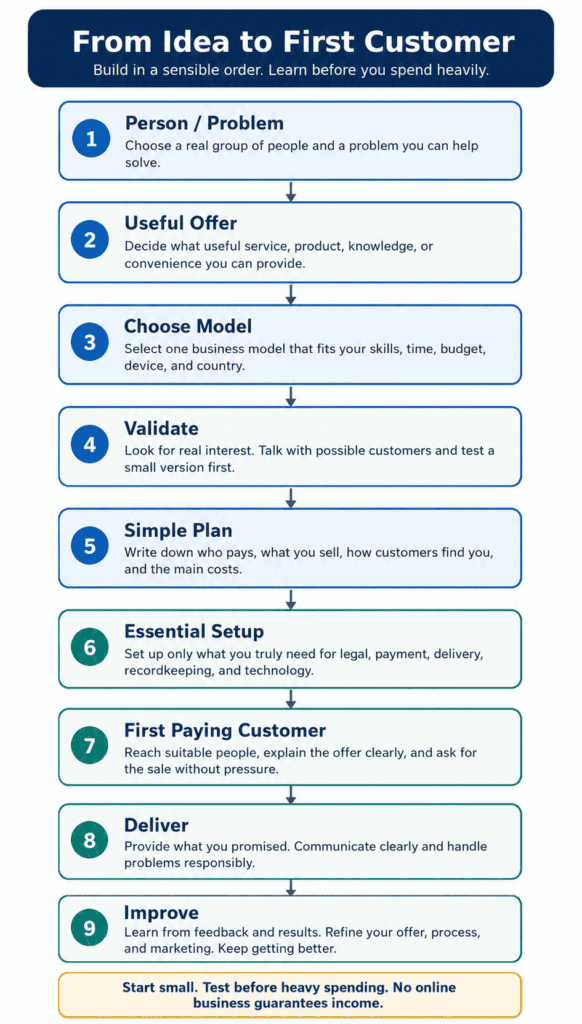
Person -> Problem -> Useful Offer -> Business Model -> Small Test -> Needed Setup -> First Customer
If one part is still unclear, work on that part before making a large financial commitment.
Key Points to Remember
- Start with a real person and a real problem.
- Choose one business model that fits your skills, time, budget, device, experience, goals, and country.
- Test your idea before spending heavily.
- Understand the difference between revenue, costs, and profit.
- Pay for and set up only what your business actually needs.
- Work toward finding a real paying customer, and provide what you promised.
- Check current legal, tax, registration, payment, and other country-specific information that applies to you.
- No online business guarantees income.