If you may earn money or receive another benefit from a recommendation, tell the reader clearly. A good affiliate disclosure should help the reader understand how you may benefit before they decide whether to follow the recommendation.
Quick Answer
| Quick Answer An affiliate disclosure tells readers that you may earn money or receive another benefit when they use your affiliate link. An affiliate link is a special link that helps a company know who sent the visitor. In the United States, the disclosure should be hard to miss and should appear with the recommendation, not hidden far away. Use simple words that explain how you may benefit. The affiliate company’s rules may add requirements. A platform is the website, app, or service you use. Platform rules may add requirements too, so check both. Fix weak or missing disclosures before publishing or promoting further. |
Visual Guide: Keep the Disclosure With the Recommendation
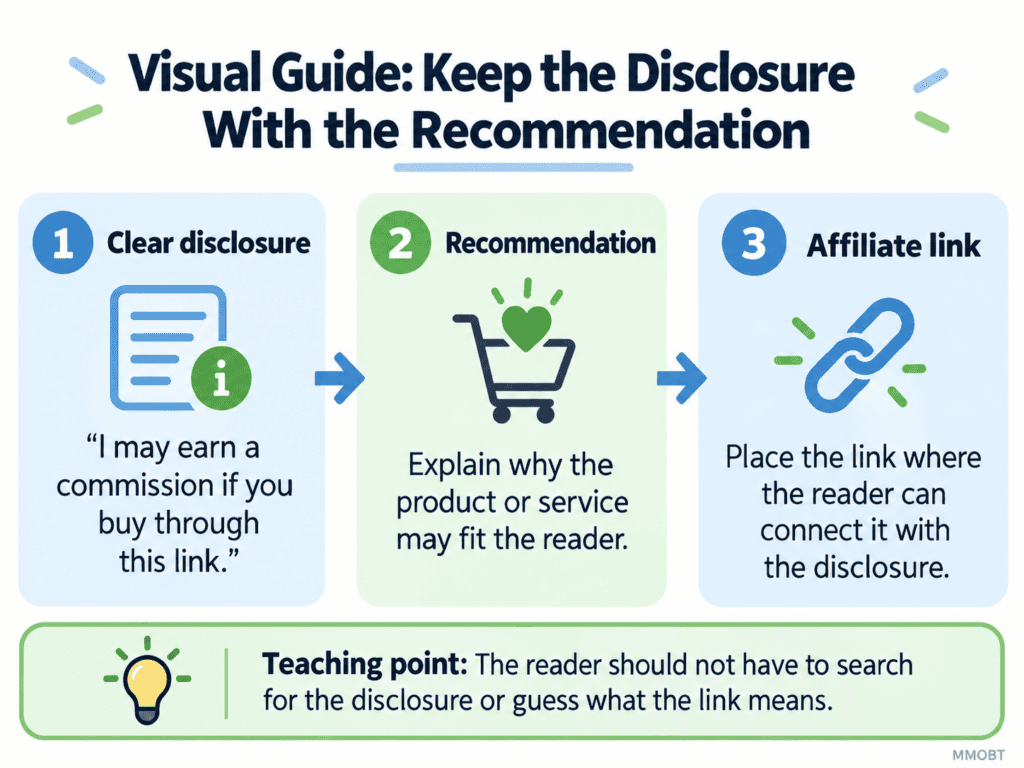
1. Clear disclosure
“I may earn a commission if you buy through this link.”
2. Recommendation
Explain why the product or service may fit the reader.
3. Affiliate link
Place the link where the reader can connect it with the disclosure.
Teaching point: The reader should not have to search for the disclosure or guess what the link means.
1. What an Affiliate Disclosure Means and Why Readers Need It
An affiliate link is a special link that helps a company know which affiliate sent a visitor. If the visitor buys or completes another required action, the affiliate may receive money. That payment is called a commission.
An affiliate disclosure is a clear statement that tells readers you may earn money or receive another benefit from a recommendation. It gives readers information that may affect how they judge what you recommend.
The Federal Trade Commission (FTC) uses the legal term “endorsement.” For this beginner guide, think of an endorsement as a message that recommends or supports a product, service, or company. In the United States, the FTC says unexpected connections should be disclosed when they may affect how people judge an endorsement. This includes the chance to earn a commission when you recommend a product through an affiliate link.
Why this matters
| Disclosure is not only a legal or policy issue. It is also a trust issue. Readers should know when a recommendation may earn you money or bring you another benefit. |
The same basic honesty helps readers in other countries, but laws can differ. Do not treat U.S. FTC guidance as the law for every country.
2. When You Need to Disclose a Financial or Other Connection
For a normal affiliate recommendation, use a disclosure when you may earn money because the reader uses your link. The reader should not have to guess that you can be paid.
A connection can involve more than a commission. A company may pay you directly, give you a free product, or give you a discount. Another benefit can matter if knowing about it could change how readers judge your recommendation.
The FTC uses the term “material connection” for a relationship or benefit that could affect how people judge an endorsement. This can include money, a free product, a discount, or another benefit. For beginners, ask one simple question: Would knowing about this help the reader judge my recommendation more fairly? If yes, make it clear.
You may have nothing to disclose if you bought the product yourself and receive no benefit from the recommendation. Do not invent a disclosure for a connection that does not exist.
3. What “Clear and Conspicuous” Means in Plain English
The current U.S. Endorsement Guides use the legal phrase “clear and conspicuous.” In plain English, this means the disclosure should be hard to miss and easy for ordinary people to understand.
That means the words, position, size, and format all matter. A disclosure can use accurate words and still fail if the reader is unlikely to notice it.
- Use plain words that explain how you may earn money or receive another benefit.
- Put the disclosure where the reader will see it with the recommendation.
- Do not hide it in a footer, About page, legal page, or poorly labeled link.
- Do not make the reader click “more” just to discover the disclosure.
- Make sure it still works on a phone, not only on a large computer screen.
- If the recommendation is spoken in a video, include a spoken disclosure. Using both audio and visible text can make it easier to notice.
A long legal paragraph is not automatically better. A short, direct statement can be clearer when it tells the reader what they need to know.
4. Where to Put Affiliate Disclosures on Articles, Reviews, and Comparisons
Put the disclosure close enough to the recommendation that the reader can connect the two. The FTC says the closer the disclosure is to the recommendation, the better.
For an article with several affiliate recommendations, a clear disclosure near the beginning may work in some situations. But do not place it so far from the recommendations and links that readers can miss the fact that you may benefit.
A reader may reach a recommendation or affiliate link without seeing or remembering the earlier disclosure. If so, add another clear disclosure near that recommendation or link.
A simple page pattern
1. Place a short affiliate disclosure before the first affiliate recommendation that may earn you money.
2. Teach the reader why you are recommending the option.
3. Place the affiliate link where the disclosure and recommendation still make sense together.
4. Repeat a short disclosure when distance, page design, or a new section could make how you may benefit unclear.
Do not rely only on one disclosure page for the whole website. A reader may never visit it.
Visual Guide: Clear vs. Unclear Disclosure
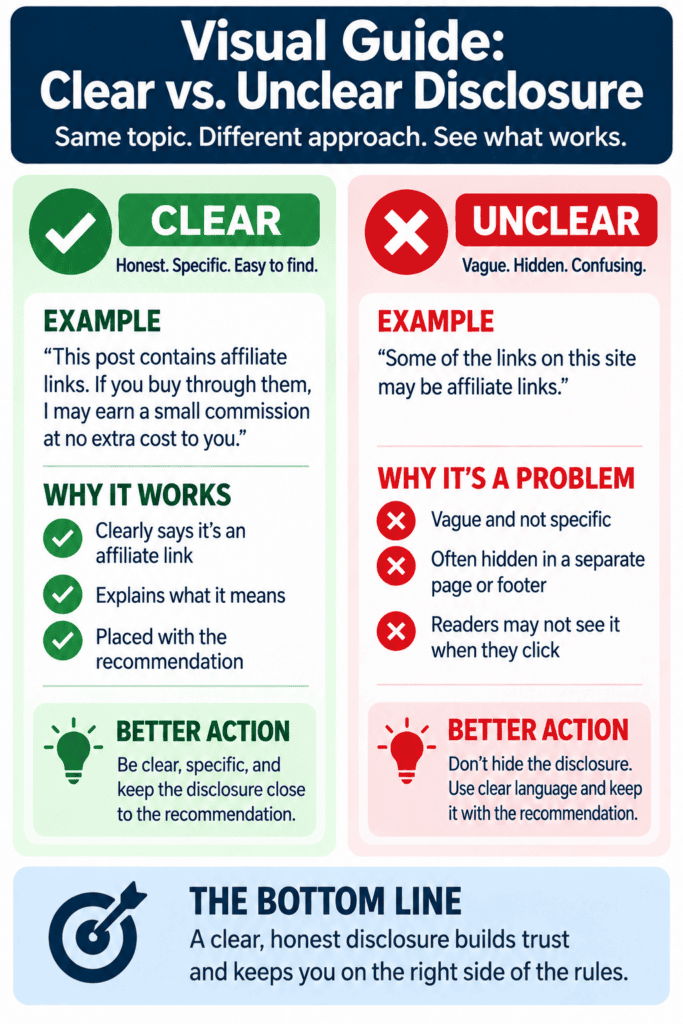
CLEAR: “I may earn a commission if you buy through this link.”
Why it works: Explains in ordinary words that you may earn money.
Better action: Place it where the reader sees it with the recommendation.
CLEAR: “This post contains affiliate links. I may earn a commission if you buy through them.”
Why it works: Explains that the person who placed the links may earn money.
Better action: Keep the statement easy to see before affiliate recommendations that may earn money.
UNCLEAR: “Affiliate link.”
Why it fails: Some readers may not know that the person who placed the link can earn money.
Better action: Explain the commission or other benefit.
UNCLEAR: Disclosure only in the footer or About page.
Why it fails: The reader can easily miss it when judging the recommendation.
Better action: Move the disclosure into the article near the recommendation.
5. How Disclosure Works on Social Media, Video, and Email
Social media posts
Put the disclosure in the post itself where people can notice it. Do not bury it among many hashtags, links, or unrelated words.
A platform is the website, app, or online service where you post. Do not assume its built-in disclosure tool is enough by itself. The FTC says a built-in tool may still be easy to miss, so the overall disclosure must remain clear.
Video and live streams
If you make an affiliate recommendation in a video, put the disclosure in the video. A visible disclosure and a spoken disclosure together are easier for different viewers to notice.
If the video description also contains affiliate links, place a disclosure in the description near those links. For a live stream, repeat the disclosure from time to time because people may join after the stream starts.
If an email recommends a product and you may earn from an affiliate link, use the same basic rule. Tell the reader that you may earn money or receive another benefit where the reader sees the recommendation and link.
Laws and platform rules can differ by country and situation. Check the rules that apply to your audience and the affiliate program you use.
6. Affiliate Disclosure Examples: Clear and Unclear Wording
There is no single sentence that works in every situation. The purpose is to give the reader the important information in words that are easy to understand.
Simple wording that usually explains the money or benefit clearly
- “I may earn a commission if you buy through links in this article.”
- “I may earn a commission if you buy through this link.”
- “This post contains affiliate links. I may earn a commission if you buy through them.”
Wording that may be too vague
- “Affiliate link.”
- “Commissionable link.”
- “Partner link.” when the wording does not explain what the partnership means for the reader.
Your disclosure should match what you actually receive. If you received a free product, say that. If you were paid directly, say that. If you earn a commission from purchases, explain that clearly.
Do not copy another website’s legal wording just because it looks professional. Your words still need to match what you actually receive and be easy for your own readers to understand.
7. Check Affiliate Program and Platform Rules
An affiliate program is an arrangement in which a company pays approved affiliates when their referrals complete a required action, such as a purchase. Its rules may add disclosure requirements. The program may require certain wording, placement, labels, or other steps in its official agreement.
Social media and video platforms may also provide built-in labels or tools for paid or sponsored content. Those tools can help, but do not assume that using one automatically meets every disclosure requirement.
Before you publish or promote
- Check the current official affiliate program agreement or disclosure rules.
- Check the current rules of the platform where you will post.
- For a U.S. audience, check current FTC guidance.
- If another country matters to your audience, check that country’s rules separately.
Rules can change. A disclosure that was acceptable years ago should not be treated as permanently correct without a fresh check.
8. Audit Existing Affiliate Content and Fix Weak Disclosures
If you already have affiliate content, do not wait for a new article before fixing weak disclosures. Start with one page, post, video, or email that contains affiliate links and work through it carefully.
1. Find every recommendation that can earn you money or another benefit.
2. Find every affiliate link connected with those recommendations.
3. Check whether the reader can understand how you may earn money or receive another benefit from your current wording.
4. Check whether the disclosure appears where the reader will actually see it with the recommendation.
5. Check the current affiliate program and platform rules that apply.
6. For U.S. affiliate endorsements, compare your disclosure with current FTC guidance.
7. Correct weak or missing disclosures before you continue promoting the content.
Small action, real protection
| You do not need to repair your whole website in one sitting. Fix one page with affiliate links correctly, then use the same audit process on the next page. |
9. Common Affiliate Disclosure Mistakes
1. Putting the only disclosure in the footer or About page
The reader may never see it while deciding whether to trust your recommendation. Put the disclosure with the recommendation instead.
2. Placing the disclosure after the affiliate link
The reader may click before learning that you may earn money or receive another benefit. Move the disclosure earlier or closer to the recommendation.
3. Writing only “affiliate link”
Some readers do not know that an affiliate link may pay the person who placed it. Explain in ordinary words that you may earn money.
4. Relying only on a platform tool
A built-in label can be useful, but it may not always be easy to notice or understand. Make it clear how you may benefit in your own message too.
5. Using one disclosure for every future post
A reader may see one post without seeing the earlier disclosure. Each recommendation should make it clear how you may benefit when a disclosure is needed.
6. Copying a legal-sounding template without understanding it
Complicated words do not create trust. Use accurate wording that explains what you actually receive and that an ordinary reader can understand.
10. Practical Action: Audit One Page With Affiliate Links Today
Choose one page or post that contains an affiliate recommendation. Do this before you move to another marketing task.
| Check | Question |
| Money or benefit | Can the reader tell that I may earn money or receive another benefit? |
| Wording | Does the disclosure explain how I may benefit in simple words? |
| Placement | Will the reader see it with the recommendation or affiliate link? |
| Mobile | Is it still easy to notice on a phone? |
| Program | Have I checked the current affiliate program rule? |
| Platform | Have I checked the current rules of the website, app, or platform I use? |
| U.S. guidance | If U.S. consumers may see it, have I checked current FTC guidance? |
Correct the problems you find. Then repeat the audit across your remaining affiliate content.
11. Key Points to Remember
- An affiliate disclosure tells readers that you may earn money or receive another benefit from a recommendation.
- For U.S. affiliate endorsements, or affiliate recommendations, the disclosure should be clear, easy to understand, and hard to miss.
- Keep the disclosure with the recommendation. Do not hide it on a separate page or below the link.
- Words such as “affiliate link” may be too vague if they do not explain that you can earn money.
- Social media, video, live streams, and email need disclosure where the recommendation appears.
- Affiliate programs and platforms may add their own rules, so check them before publishing.
- Fix weak disclosures on existing content, one page or post at a time.
Official U.S. Guidance
For U.S. disclosure questions, use current official guidance rather than copying another affiliate website. The sources below were checked for this draft on 15 September 2026.
FTC – The Endorsement Guides: What People Are Asking
eCFR – 16 CFR Part 255, Guides Concerning Use of Endorsements and Testimonials in Advertising
FTC – Disclosures 101 for Social Media Influencers
Important
| This article gives general educational information. It is not legal advice for your specific situation. Disclosure laws and program rules can differ by country and can change over time. |