How to Make Money Online: Honest Options for Beginners
By Roy and Daphne Okonkwo
People often hear “make money online” and imagine one kind of work. In reality, the internet gives you several different ways to earn.
You might work for an employer, use a skill for other people or businesses, sell something, or build an online business.
Those choices are not the same. Before you pick one, you need to know who will pay you, what you will give them, and what you will need to do.
Quick Answer
Making money online means doing work, selling something, or providing something useful through the internet and getting paid for it.
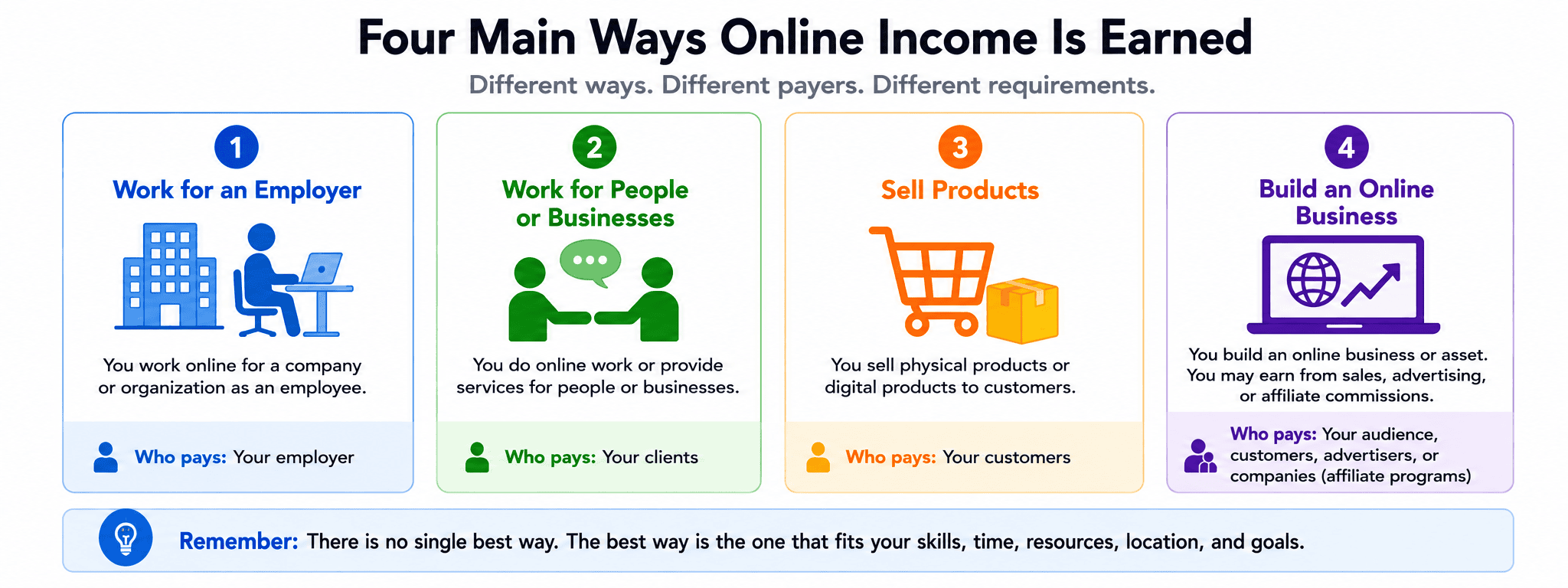
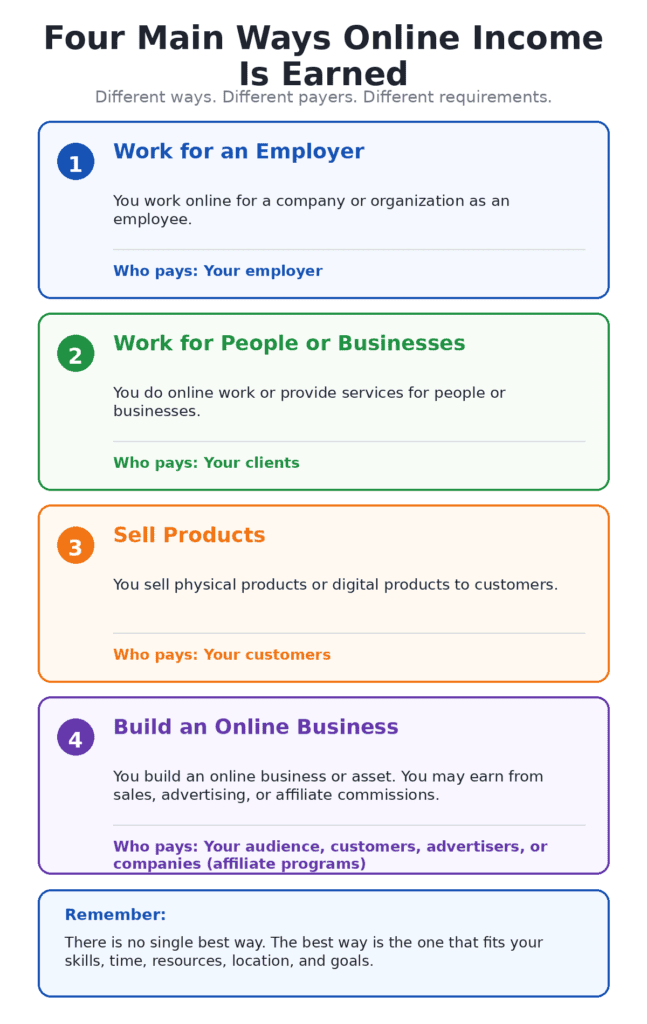
There are four ways. You can work for an employer, do paid work for people or businesses, sell products, or build an online business.
An online business may earn money from sales, advertising, or affiliate commissions.
Some ways may help you start earning sooner. Others take more time to build. None guarantees that you will make money.
Choose one way that fits your skills, time, money, device, and country. Find out what it requires, how you will be paid.
Then check what risks or costs you need to know about. Start with one test instead of trying several ways at once.
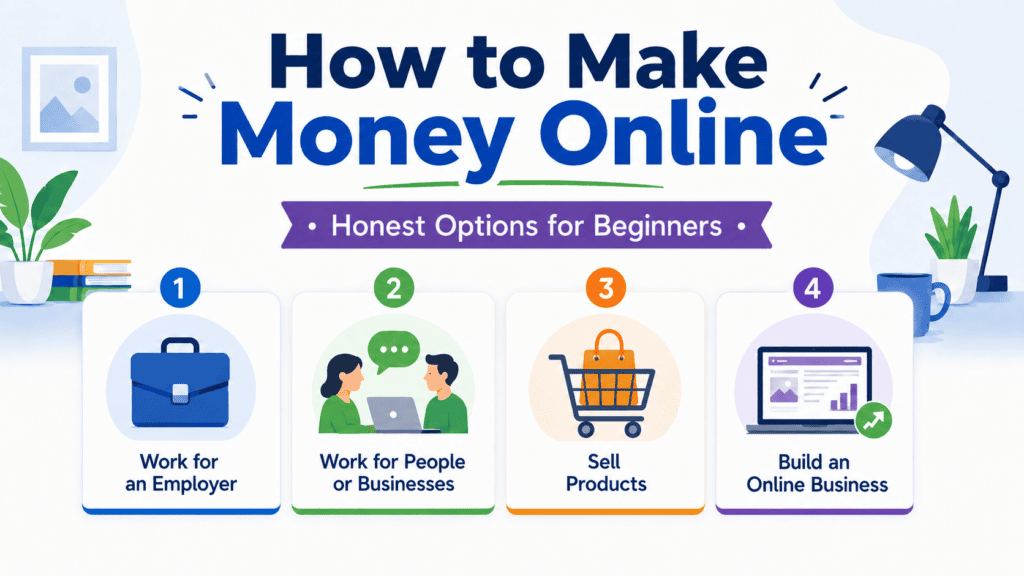
Table of Contents
- Quick Answer
- Why This Matters
- What Making Money Online Really Means
- The Four Main Ways to Make Money Online
- Compare the Four Ways Before You Choose
- Which Way of Making Money Online Fits You?
- What “Free,” “Easy,” and “Passive” Really Mean
- How to Check an Online Money-Making Opportunity Before You Join or Pay
- Start With One Small Test, Not Five Methods
- Your First 7 Days and Where to Learn Next
- Useful Examples
- Common Mistakes
- Practical Action
- Key Points to Remember
- If You Choose Affiliate Marketing
Why This Matters
There are many ways to make money online, but they do not all work the same way. What works for one person may not suit another.
If you choose a way to make money online before you understand what it requires, you may waste time or money.
You may also believe a false promise or choose something that is not suitable for you.
Learn how the main ways of making money online work before you decide where to begin.
This can help you choose a way that fits your situation and avoid promises that are not true.
What Making Money Online Really Means
Making money online still means giving something useful and getting paid for it.
Someone pays because you do useful work, provide a service, sell a product, teach something, or create something people want to use.
The internet may be where you find the work, talk with people, deliver what you made, or receive payment.
But the money still has a source: an employer, a customer, a business, an advertiser, or another company.
A good question to ask is: Who is paying me, and what am I giving them in return?
The Four Main Ways to Make Money Online
For a beginner, it is easier to understand the subject by putting the many online opportunities into four broad groups.
1. Work for an Employer
In this model, a company or organization hires you for a job.
You may work from home or another location and use the internet to communicate, receive tasks, and send in your work.
Your pay comes from the employer, just as it would in another job.
2. Do Paid Work for People or Businesses
Here, the focus is the work you do for a person or business. You use a skill—such as writing, graphic design, social media help, or office support—and they pay you for the service.
You may work with one customer or several, depending on the kind of work you do.
3. Sell Products
Selling online means offering something people can buy. It may be a physical product, or a digital product such as an ebook, template, or course.
The product may be your own, or it may come from another business. Either way, the customer pays for what is being sold.
4. Build an Online Business
This way is different because you are building something that can keep serving people over time.
For example, a website, blog, YouTube channel, email list, or another online project.
As it grows, it may earn from sales, advertising, or affiliate commissions.
If this is the direction you choose, read How to Start an Online Business: A Beginner’s Guide for a fuller beginner lesson.
Affiliate marketing fits here. You tell people about products or services that may help them.
If someone uses your affiliate link and the action meets the company’s rules, the company may pay you a commission.
A commission is the payment you receive for an approved sale or other qualifying action.
If affiliate marketing is the direction you choose, read Affiliate Marketing for Beginners for a fuller beginner lesson.
Compare the Four Ways Before You Choose
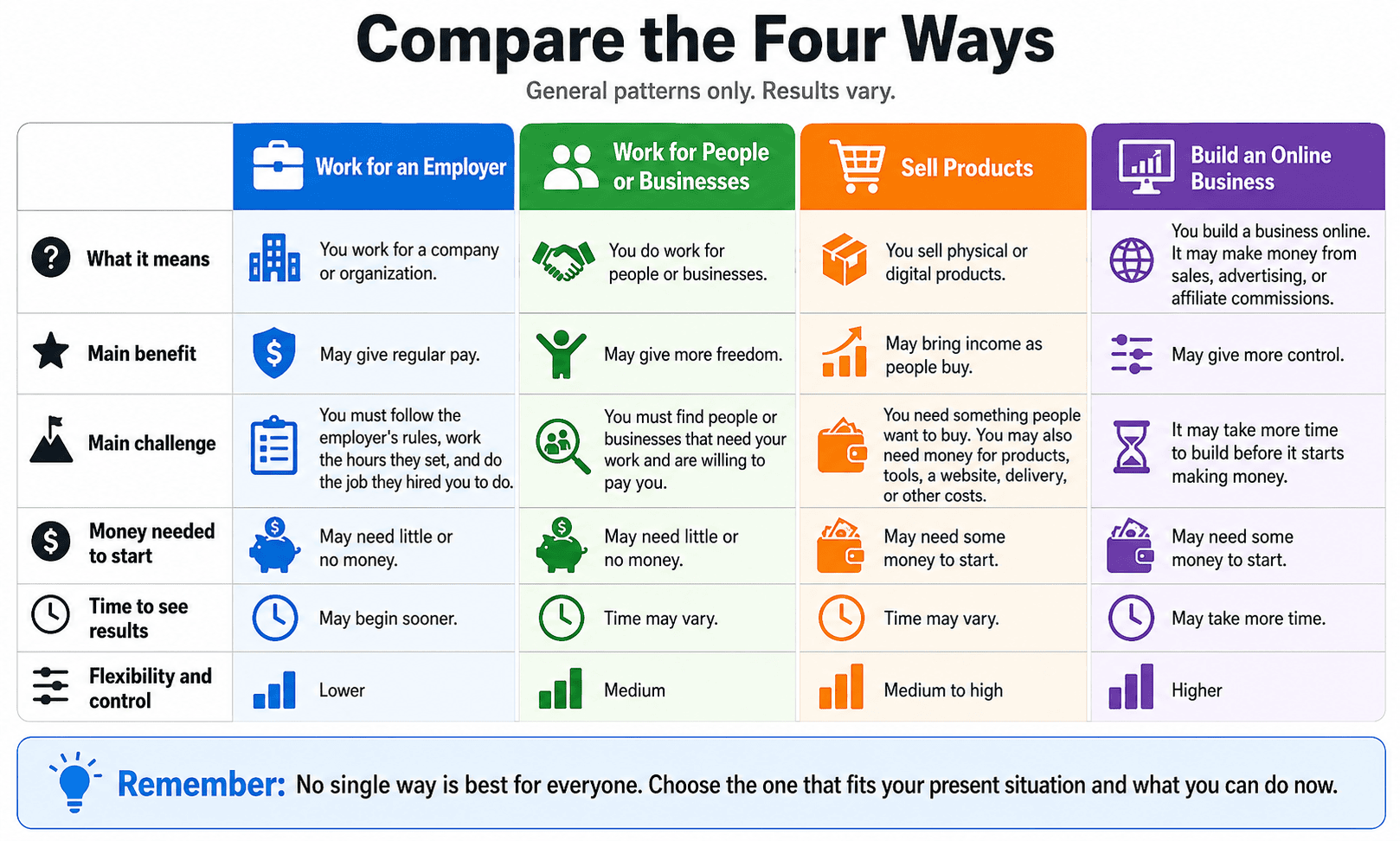
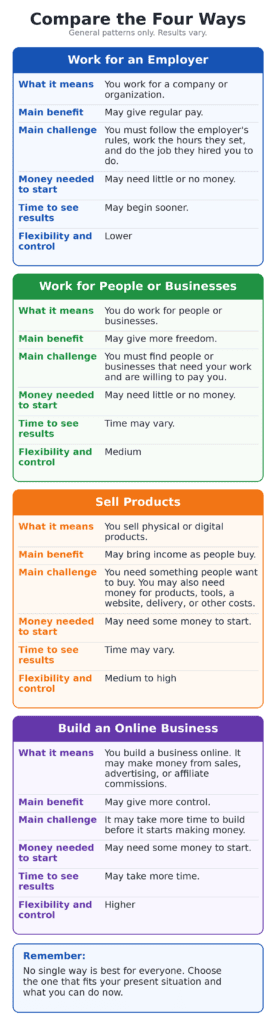
Now compare the four models before deciding. Ask four practical questions: Who pays me? What must I do? What might I need to spend? Can I actually use this option where I live?
With an employer, it is usually clear who pays you and what job you must do. However, the employer normally sets important rules, and some jobs have fixed hours.
Paid work for people or businesses can give you more choice about the work you accept. The hard part is finding people who need your skill and are willing to pay for it.
With products, you need something people genuinely want to buy. Depending on what you sell, you may also need money for tools, a website, delivery, or other costs.
An online business can give you more control over what you build and teach. It also asks for patience, because useful content, trust, and an audience usually take time to grow.
That is why there is no single best choice. The right starting point is the one that fits your situation now.
Which Way of Making Money Online Fits You?
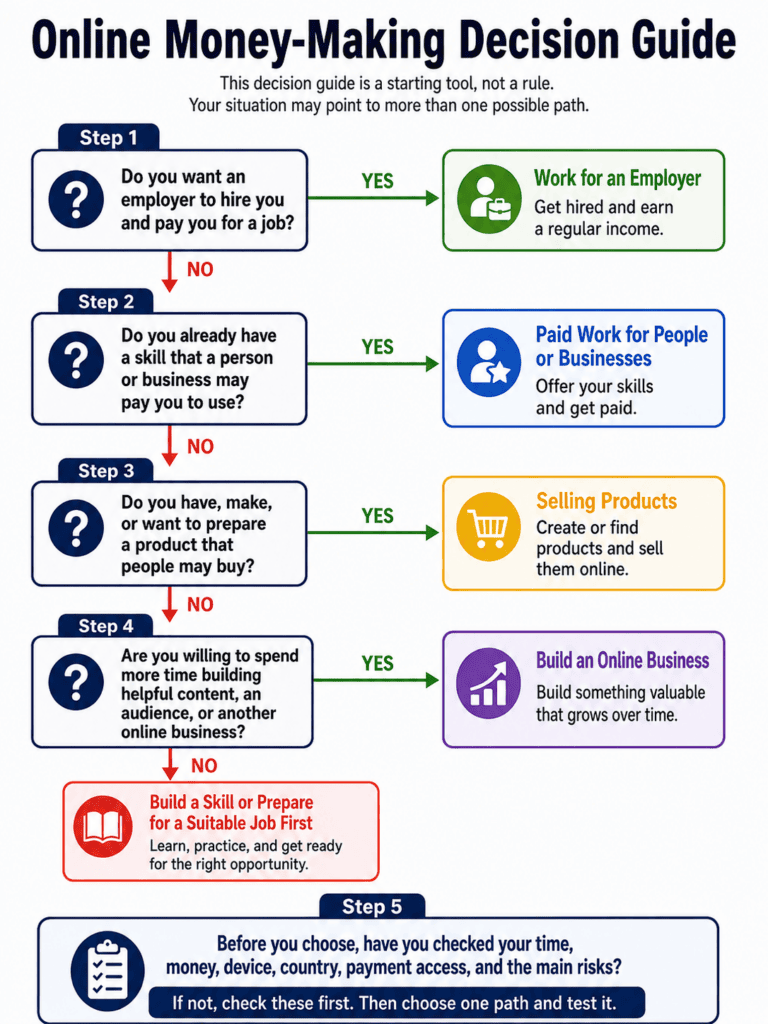
Start with your present situation, not with somebody else’s success story.
What can you already do? How much time can you give? How much can you safely spend? Do you have the phone, computer, and internet access you need?
Then think about the kind of income you need.
If you would rather be paid for work you do now, a job or paid work for other people may be a better place to begin than first trying to build a website, channel, or online business.
Selling products or building an online business may need more preparation. You may have to create something, learn a skill, buy a tool, or spend time building trust before money comes.
Location matters too. A job, payment service, website, or platform that works in one country may not be available in another.
So do not choose a way just because it looks good online. Choose one you can understand, start, and keep doing with the time, money, and tools you have.
What “Free,” “Easy,” and “Passive” Really Mean
The words free, easy, and passive can confuse beginners. They may be true in one sense but still make something seem easier than it really is.
Free often means there is no joining fee. It does not mean you will need nothing else. You may still need a phone or computer, internet access, tools, or time to learn.
Easy can mean easy to sign up for or easy to understand. That is very different from easy to earn money from.
Passive income also needs to be explained clearly. It may continue after you have done some of the main work.
But you usually need to do work at the beginning, and you may still need to do some work later.
Before you commit to anything, find out what it will really cost you in time, money, and effort.
How to Check an Online Money-Making Opportunity Before You Join or Pay
Before you join an online job, business, or money-making opportunity, stop long enough to understand the deal.
Who is supposed to pay you? What exactly do you have to do? Why would that person or company pay for it?
Then read the rules. Check the fees, how you will be paid, who is allowed to join, and whether the opportunity is available in your country.
Be especially careful when somebody asks you to pay before you can get a job.
Also be careful if a supposed employer or business opportunity asks for personal or payment information. Make sure you understand why they need it before you give it to them.
For readers in the United States, the Federal Trade Commission warns that honest employers do not ask you to pay to get a job.
The FTC also warns about fake-check job scams. If a supposed employer sends you a check and tells you to send some of the money somewhere else, stop and check the offer carefully.
Do not give a supposed employer, recruiter, or business opportunity your password or online banking login.
Screenshots and income claims are not enough.
Check the company or person and read the official information. Look for warnings or complaints from other people before you give them money or important personal information.
A little checking at the beginning can save you from a much bigger problem later.
Start With One Small Test, Not Five Methods
A common beginner mistake is trying too many methods at once. When your attention is split five ways, it becomes hard to learn any one of them well enough to judge it fairly.
Pick one way and give yourself one small test. Apply for one suitable job. Offer one service. List one product. Or create one useful article or video.
Then pay attention to the result. What worked? What confused you? What do you need to learn before the next attempt?
Your First 7 Days and Where to Learn Next
For the first seven days, stay with the one way you chose. Do not make the week about earning a set amount of money.
Make it a learning week. Your aim is to understand how that way works and complete a few real steps.
Choose one small result you can finish: a job application, a service offer, a product prepared for sale, or your first useful article or video.
At the end of the week, look at what you actually did—not what you hoped would happen. Then decide what to repeat, what to change, and what you still need to learn.
If you choose affiliate marketing, continue with Affiliate Marketing for Beginners. If you choose another way, keep learning the skills, costs, rules, and risks that apply to that way before you spend money.
Useful Examples
Here are four simple examples we created to show how the different ways of making money online may work. The people in the examples are not real.
1. Working for an Employer
Maria applies for an online customer-support job. A company hires her to answer customers’ questions from home.
The company pays her for doing the job.
2. Working for People or Businesses
Jamal knows how to design simple graphics. He finds a small business that needs help and agrees to create some graphics for them.
The business pays him for the work he completes.
3. Selling a Product
Anita creates a short book that teaches something she knows well. She sells it online for people to read on a phone or computer.
When someone buys the book, she receives money from the sale.
4. Building an Online Business
Daniel starts a blog that teaches people about a subject he understands. Over time, he adds useful articles and helps more people find answers.
Later, the blog may make money from advertising or affiliate commissions when readers buy through his affiliate links.
They are only examples. They do not promise how much money anyone will make.
Common Mistakes
- Starting several methods at once. Choose one main way first so you can learn what it requires and judge your results.
- Treating free, easy, or passive as no cost or no work. Check how much time, internet access, learning, and money you may need. Also check whether you need a phone or computer.
- Trusting screenshots or earnings claims without checking the source. Look for clear evidence and understand what work produced the result.
- Paying for the promise of a job. In the United States, the FTC warns that honest employers do not ask you to pay to get a job.
- Ignoring country, payment, age, tax, or eligibility rules. Check the rules that apply to you before you depend on an opportunity.
- Buying tools before you know why you need them. Start with what you have and pay only when a tool solves a clear problem.
Practical Action
Choose one way you can begin with the skills, time, money, and tools you have now.
Write down one small thing you can do during the next seven days. It may be applying for a suitable job, offering one service, preparing one product for sale, or creating one useful article or video.
Before you spend money, check the rules and costs. Find out how you will be paid and whether that way of making money is available in your country.
Do not give anyone important personal information until you know why they need it.
At the end of the seven days, look at what happened. Then decide what to do next.
You may continue with the same way, change something that did not work, or learn what you need before you continue.
Key Points to Remember
- There are four main ways to make money online. You can work for an employer, work for people or businesses, sell products, or build an online business.
- No way can promise you that you will make money.
- Choose a way that fits what you know how to do and the time and money you have. Also check that you have the phone or computer you need and that you can use that way in your country.
- Do not assume that free, easy, or passive means no cost or no work.
- Check the rules, costs, payment method, and risks before you spend your money or give important personal information.
- Start with one way and one small test. Learn from what happens before you decide what to do next.
If You Choose Affiliate Marketing
If affiliate marketing is the way you choose, the Free Affiliate First 7 Days Kit can help you take your first steps slowly and clearly. Send me the free Kit.