Getting an affiliate link is only the beginning. You still need a sensible way to place that link in front of people who may truly need the product or service.
Good affiliate promotion does not mean putting your link everywhere you can.
It means helping the right people with useful content, then giving them the link when it helps them take the next step.
1. Quick Answer
To promote affiliate links, first create useful content for people who have a real reason to care about the product.
Choose one promotion channel — the place or method you use to reach people — that fits your audience and skills.
Check that both the affiliate program and the website, app, or service you use allow your planned method.
Place the link naturally where it helps the reader, and clearly tell people when you may earn from it.
Start with one method and track what happens. Do not spam links or rush into paid tools or advertising before you understand the rules and costs.
2. Why This Matters
Where you place an affiliate link can affect both trust and results.
A useful link in the right place can help a reader take the next step. The same link dropped into an unrelated comment, group, or message can feel like spam.
The goal is not to spread links as widely as possible. The goal is to reach people who have a real need, help them first, follow the rules, and make the affiliate relationship clear.
If you still need the basic picture of how affiliate marketing works, start with our Affiliate Marketing for Beginners guide.
This article focuses on the next job: promoting a link safely and usefully.
3. What Promoting Affiliate Links Really Means: Help First, Link Second
An affiliate link is a special link that helps a company know which affiliate sent a visitor.
If the visitor completes the required action, such as buying a product, the affiliate may earn a commission. A commission is money the affiliate may receive for that referral.
But the link itself is not the main thing. The useful content around it is what gives the link a reason to be there.
Suppose a reader wants to choose a microphone for recording videos. You could write an article that explains what beginners should look for.
If one microphone fits that lesson, an affiliate link beside the explanation may help the reader learn more or buy it.
That is very different from placing the same microphone link in an unrelated discussion and hoping someone clicks it.
Simple rule: Content first. Helpful link second.
Before you promote a link, ask one question: Does this link help the person who is reading, watching, or listening? If the answer is no, the link probably does not belong there.
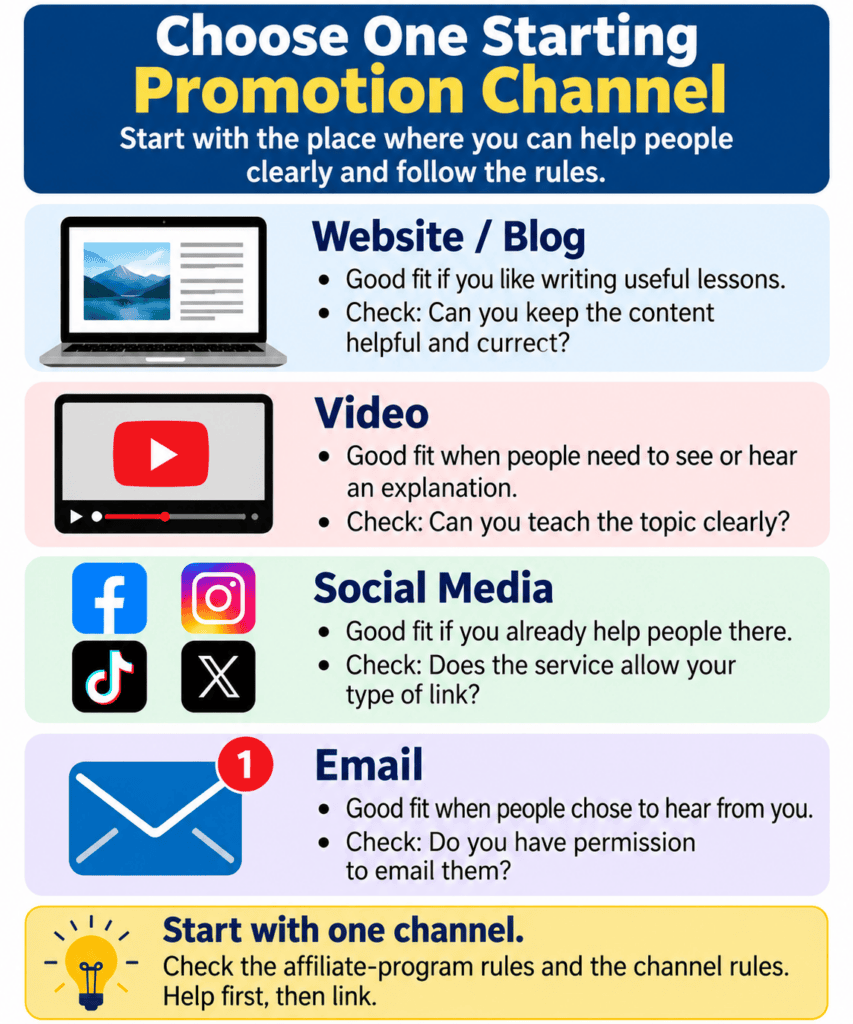
4. Choose One Promotion Channel That Fits You
A promotion channel is the place or method you use to reach people. It may be a website, video, social media, or email. You do not need to use all of them at once.
Choose one channel that fits your audience, skills, time, and type of content.
A person who enjoys writing may start with a website or blog. Someone who explains things well on camera may prefer video.
A person with a useful social audience may start there, while someone with an email list may use email.
Do not begin by asking, “Which channel can show my link to the most people?” Instead ask, “Where can I give useful help?” Then think about the people who may genuinely need the offer.
If you have not yet chosen a suitable affiliate program, our Best Affiliate Programs for Beginners guide can help with that earlier decision.
Before using any channel, check the rules. The affiliate program may allow one method and restrict another.
The website, app, or service where you share content may also have its own rules. Do not assume a method is allowed because you saw someone else use it.
5. Match Each Affiliate Link to a Real Reader Need
A link becomes more useful when the offer matches the problem the reader is trying to solve. Start with the reader’s need, then ask whether the product or service can reasonably help.
Imagine that you are teaching someone how to start a simple affiliate website. A link to a suitable website-building service may fit naturally because the reader may need a website.
A link to an unrelated design tool would make less sense if the lesson does not create that need.
The same principle applies to physical products, software, services, courses, and other affiliate offers.
Do not start with a product that pays a commission and then search for somewhere to push it.
This protects trust.
When your recommendations usually make sense, readers have a reason to keep listening. If every piece of content becomes an excuse to place another link, that trust can disappear quickly.
6. Promote Affiliate Links Through Useful Website or Blog Content
A website can be a useful channel when written content fits the people you want to help. You can answer real questions, compare suitable options, or teach a task.
Then you can add an affiliate link where the product or service becomes relevant.
For example, imagine that you compare two tools for a beginner task. Explain what each tool does, who may find it useful, and where its limits are.
If the reader wants to learn more about one option, a clearly identified affiliate link can be useful at that point.
Tutorials can work in the same way. If one step truly requires a tool, mention a suitable option and provide the link.
Do not fill every paragraph with links. One useful link at the right point can serve the reader better than several repeated links.
You also do not need a website simply because you are an affiliate marketer. A website becomes useful when it fits the way you plan to reach and help people.
If you later decide that a website is the right channel, our Best Website Builder for Affiliate Marketing guide can help you examine that choice.
7. Use Video and Social Media Without Spamming
Video can work well when people need to see how something works. You might demonstrate a product, explain a task, compare options, or answer a common question.
If the affiliate program and video service permit affiliate links, place a relevant link only where the rules allow it.
Social media can work in a similar way. Start with the useful post, explanation, or demonstration.
Add a link only when it belongs naturally with that content, and do not turn every post into a promotion.
Be especially careful with groups, communities, comments, and private messages. Dropping links into conversations that did not ask for them can look like spam.
A group or community may also forbid commercial links.
Respect the rules. If direct affiliate links are not allowed, do not look for tricks to get around the restriction. Find a permitted way to help people, or use another channel.
8. Use Email Only With Permission
Email can be useful because it lets you continue helping people over time. Use it with people who have chosen to receive messages from you.
Follow the rules that apply to your email service, affiliate program, and country.
A good affiliate email should still be useful even if the reader never clicks the link.
You might teach a short lesson, explain a problem, and mention a product only when it genuinely helps with part of the solution.
Do not hide the fact that the link may earn you money.
Also avoid sending one promotional email after another simply because a company pays a commission. Your email list is made of people, not commission opportunities.
9. Be Careful With Paid Promotion
Paid advertising can put an offer in front of people quickly, but it can also create costs quickly. For many beginners, it is better to learn with a simpler method first.
Before paying for ads, check whether the affiliate program allows your planned advertising method.
Some programs limit how affiliates may use ads, company names, or direct links. The advertising service may have separate rules.
You also need a simple way to compare what you spend with what the promotion produces. Without that information, you may lose money while trying to learn.
You do not need paid ads to begin promoting affiliate links. Start with a method you can understand and manage. Learn what people respond to before adding another cost.
10. Place Affiliate Links Naturally and Disclose Them Clearly
An affiliate link should appear where it makes sense. If you recommend a product while explaining a problem, place the link close to the recommendation or useful next step.
Do not force links into sentences just to create more chances for a click.
You must also tell readers clearly when you may earn from an affiliate recommendation. This is called an affiliate disclosure.
A disclosure is a clear statement that tells readers you may receive money when they use an affiliate link.
Do not hide the disclosure where people are unlikely to notice it.
Exact requirements can differ by country, affiliate program, and the website, app, or service where you publish. We will verify the current United States rules and any service-specific rules before publication.
For the full beginner lesson, continue with Affiliate Link Disclosure: A Simple Guide for Beginners.
Also be careful with services that shorten or change how an affiliate link appears. Do not assume those methods are allowed. Check the affiliate program and the place where you plan to share the link before using them.
11. Track Your Results Before Adding More Channels
Tracking means recording enough information to learn what happened after you promoted the link. You do not need a complicated system when you begin.
Start with one promotion method. Look at the information available to you, such as whether people saw the content and clicked the link.
If the affiliate program reports later actions, you may also be able to see whether the clicks led to the required result.
Do not judge your whole affiliate effort from one click or one quiet day. The first test is mainly for learning.
If people read but do not click, the offer may not fit their need. Your explanation may also be unclear, or the link may appear at the wrong point.
If very few people saw the content, that is a different problem.
Changing many things at once makes it hard to know what helped. Improve one method first, then consider adding another channel when you have a clear reason.
12. Know When a Paid Tool Is Really Needed
You can promote affiliate links without buying a large collection of tools. First identify the problem, then decide whether a tool would actually solve it.
A website tool may become useful when you need a website you control for articles and other content.
An email service may become useful when people want to join your list. A tracking tool may become useful when the information you already have is no longer enough.
The need should come before the purchase. Sometimes a free or simple method is enough.
When a paid tool becomes genuinely useful, MMOBT can guide the reader to a separate article that compares suitable choices.
This article should not become a shopping page. Its job is to help you promote affiliate links safely and usefully.
13. Common Mistakes to Avoid
Dropping links into unrelated places
Do not put affiliate links into unrelated comments, groups, forums, or private messages. Create useful content and place the link where people have a real reason to use it.
Promoting the wrong product
A popular product is not automatically the right product for your audience. Choose an offer that fits the reader’s actual problem.
Hiding your affiliate relationship
Do not make people guess whether you may earn from a link. Give a clear disclosure where people can notice it.
Trying to avoid program or service rules
Do not disguise links or search for ways around restrictions. If a promotion method is not allowed, use a permitted method instead.
Starting paid ads too early
Do not spend money on advertising before you understand the rules, costs, and way you will track the results. Learn with a simpler method first.
Trying too many channels at once
You do not need a blog, several social accounts, video, email, and paid advertising at the same time. Learn one method before adding another.
Buying tools before you need them
A paid tool should solve a real problem. Do not create a problem simply to justify buying the tool.
14. Your First Affiliate-Link Promotion Test
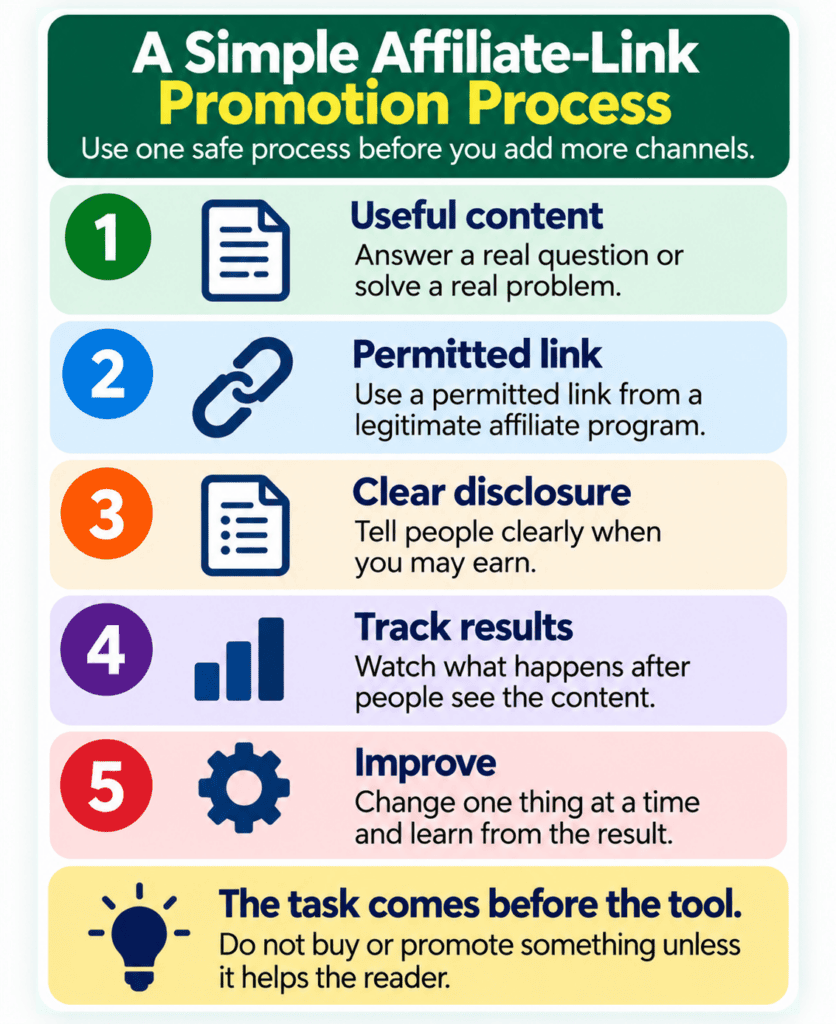
Use the steps below for one small test. The aim is to learn a safe process, not to promise income in one week.
Step 1: Choose one promotion method
Pick one channel you can manage now. It might be an article, video, social post, or email to people who chose to hear from you.
Step 2: Check the rules
Read the affiliate program rules for your chosen method. Also check the rules of the website, app, community, or email service you plan to use. Make sure your method is allowed before continuing.
Step 3: Create one useful piece of content
Answer a real question or help solve a real problem. Do not begin with, “Where can I put my link?” Begin with, “What useful help does this person need?”
Step 4: Add the link naturally
Place the affiliate link where it helps the reader take a sensible next step. Do not repeat it unnecessarily.
Step 5: Add a clear disclosure
Tell people clearly when you may earn from the link. Do not make them search for that information.
Step 6: Track the test for one week
Watch the information available to you. Look at whether people see the content, whether they click, and any further results the affiliate program reports. Use the week to learn, not as a promise of income.
Step 7: Improve before adding another channel
Ask what worked and what did not. Improve the content, offer, link position, or channel if there is a good reason. Then decide whether you need another promotion method.
Your primary next lesson is Affiliate Link Disclosure: A Simple Guide for Beginners. It explains how to tell readers clearly about an affiliate relationship.
For true beginners only: If you are still in your first days of affiliate marketing, the Free Affiliate First 7 Days Kit may help. It gives you a simple order to follow. It is optional, and this article is complete without it.
15. Key Points to Remember
- Help people before asking them to click an affiliate link.
- Choose one promotion channel that fits your audience, skills, and content.
- Match the product or service to a real reader need.
- Check both the affiliate program rules and the rules of the place where you promote.
- Use website, video, social media, or email only where each method genuinely fits.
- Treat paid advertising as a later step, not a beginner requirement.
- Place affiliate links naturally inside useful content and disclose the relationship clearly.
- Track one method and improve it before adding more.
- Buy a tool only when it solves a real problem.
Promoting affiliate links is not about putting links in as many places as possible. It is about reaching the right person with useful information.
Follow the rules and be open about your financial relationship. Give the reader a sensible next step.
Start with one useful piece of content and one permitted link. Then learn from what happens.