Starting an online business is one step. Finding people who may need what you offer is another.
This is where many beginners become overwhelmed.
They hear about social media, email, search engines, paid ads, content, referrals, marketplaces, and many other ways to market a business.
You do not need to use all of them. A better place to start is with one simple question:
Who are you trying to help?
Once you know that, you can choose one or two realistic ways to reach those people. Then you can test what works before doing more.
Quick Answer
To market an online business, start with the customer and the offer.
Be clear about who you want to reach, what problem you help solve, and what you want the person to do next.
Then choose one or two realistic places where those people are likely to be. Run a small test before spending too much time or money.
Measure useful responses such as inquiries, email signups, suitable leads, booked calls, trials, or sales.
Do not judge success only by views or followers. Improve what works before adding more marketing channels.
Why This Matters
Marketing can become expensive and confusing when you try to do too much at once.
A beginner may open several social media accounts, start writing content, build an email list, pay for ads, join online groups, and buy several marketing tools.
That may feel productive, but being busy is not the same as reaching suitable customers.
Every marketing method takes something from you. It may take money, time, skill, attention, or a mix of these.
Starting with one or two methods makes it easier to see what is working.
It also helps you avoid spending money on tools or advertising before you really understand your customer.
The goal is not to be everywhere.
The goal is to reach the right people with a clear and useful offer.
Know Who You Want to Reach
Before you choose how to market your business, decide who you are trying to reach.
You do not need a complicated customer profile. A simple description is enough to start.
Ask yourself:
- Who has the problem I help solve?
- What does this person need or want?
- Why might this person look for help now?
- Where might this person already look for this kind of help?
Suppose you offer bookkeeping help for very small businesses. Your first customer description might be:
A small business owner who is falling behind on basic bookkeeping and wants help getting the records organized.
That is much clearer than saying:
My customer is anyone who owns a business.
When you understand the person more clearly, choosing where to reach them becomes easier.
Do not try to reach everyone at the beginning. Start with people whose needs match what you offer.
Make the Offer Clear
Once you know whom you want to reach, make sure your offer is easy to understand.
A simple offer should answer three questions:
- What problem do you help with?
- What useful result do you provide?
- What should the person do next?
For example:
“I help small online sellers organize their bookkeeping records so they can understand what is coming in and going out. Contact me to discuss the records you need help with.”
You do not need big promises that may not be true. There is no need to say that your service is amazing, life-changing, or the best.
Clear is better than trying to sound impressive. A person should understand what you offer without having to guess.
This matters because more marketing will not help much if people do not understand the offer.
You can put an unclear message in front of many people and still get little response.
So before adding another marketing method, first ask whether the offer itself makes sense.
Choose Where to Reach Them
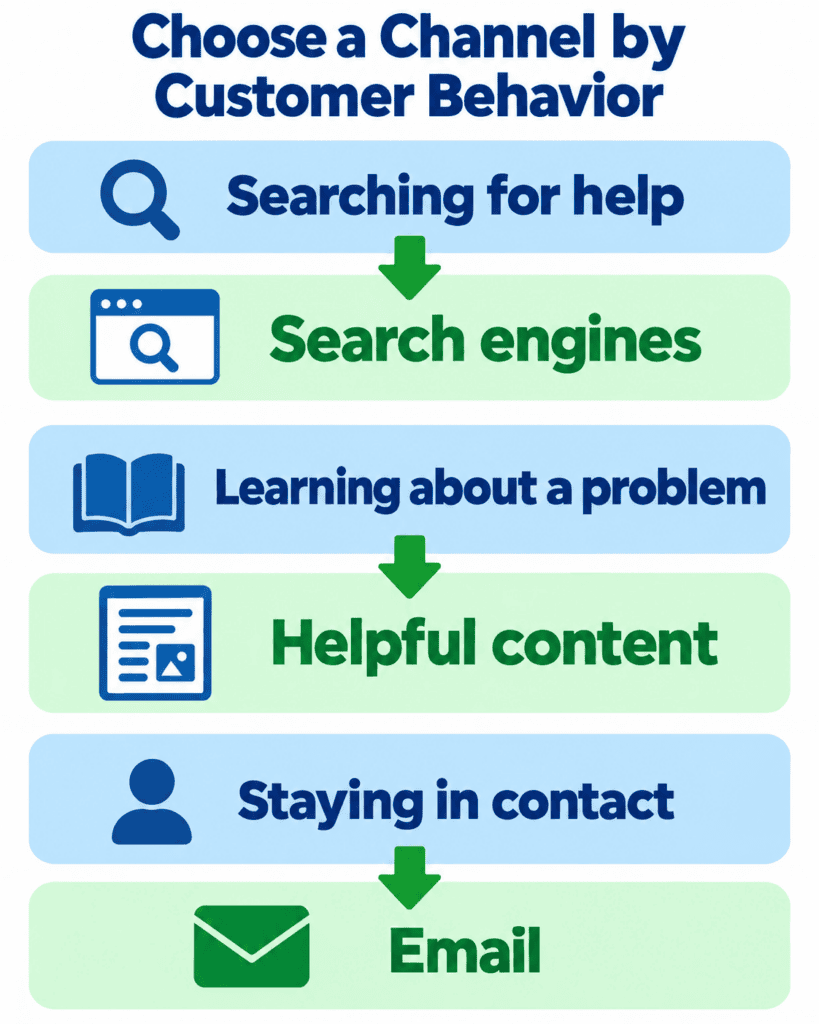
A marketing channel is simply a way or place you use to reach possible customers. Different customers use different channels.
A person looking for an urgent service may search online.
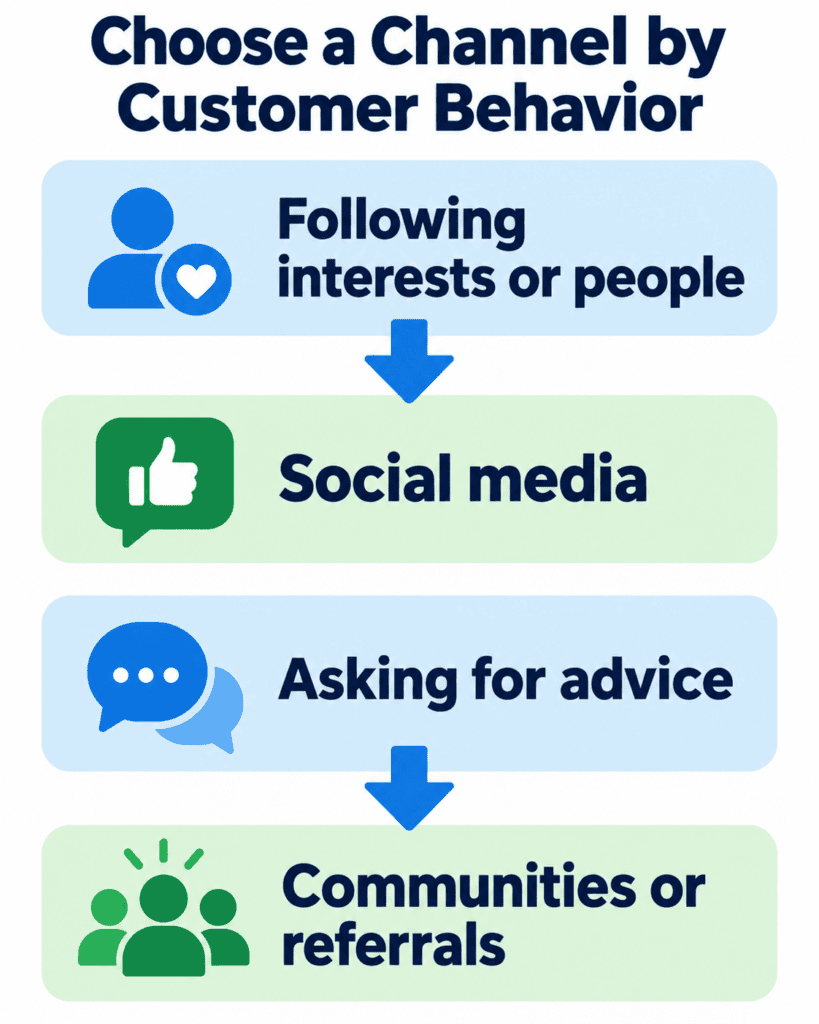
Someone learning about a new subject may watch videos, read articles, or follow helpful social media accounts.
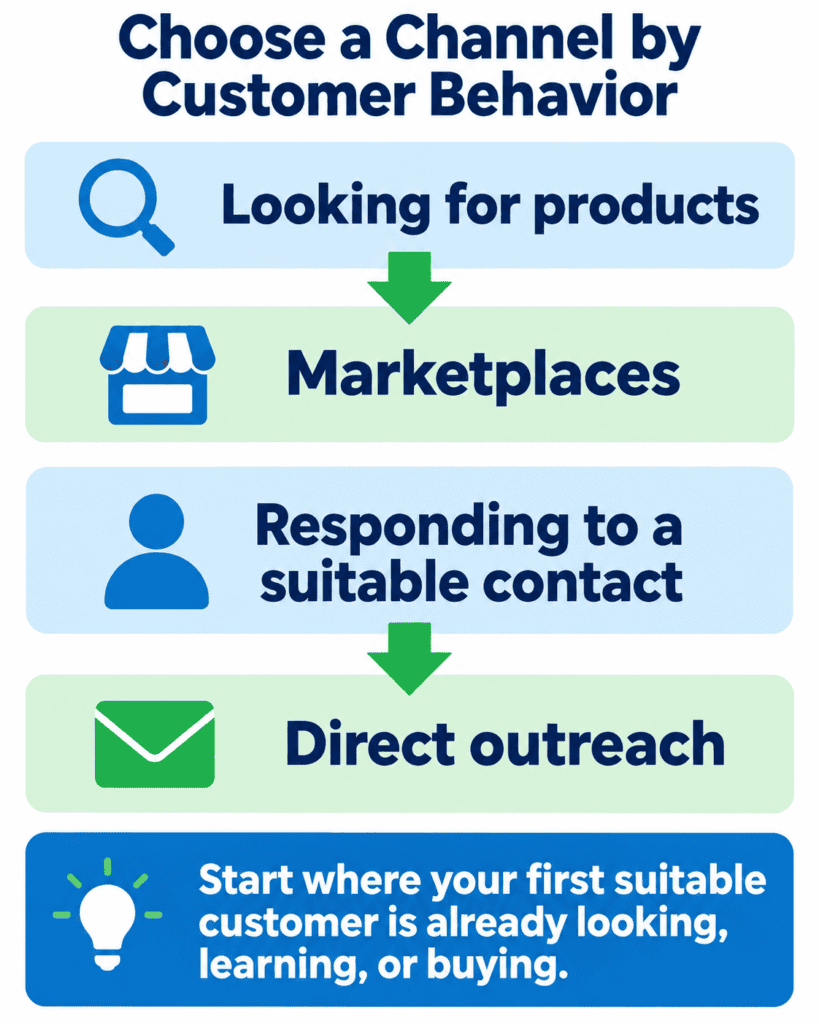
A buyer looking for a product may search an online marketplace, which is a website where sellers offer products to buyers.
A business owner looking for professional help may respond better to referrals, useful content, networking, or direct contact.
Common marketing channels include:
- Search engines
- Helpful content
- Social media
- Online communities
- Referrals
- Marketplaces
- Direct outreach
- Paid advertising
Direct outreach means contacting suitable people or businesses directly when there is a reasonable reason to believe your offer may help them.
You do not need to use every channel on this list. Instead, ask:
Where is my customer most likely to look, learn, compare, ask for help, or buy?
The answer will depend on the type of business you have. A service business may need a different starting channel from a digital product business.
A business selling handmade products may need a different starting channel from someone offering online consulting.
Choose the channel because it fits the customer. Do not choose it only because many other businesses use it.
Choose a channel by watching what your customer is already trying to do.
Choose Only One or Two Channels First
Beginners often feel pressure to be everywhere.
You may hear that every business needs a website, several social media accounts, email, ways to appear in search results, videos, ads, and other tools.
That can become too much very quickly. Start with one or two channels that make sense for your customer and your business.
There are several good reasons for this.
You Have Limited Time
Every channel needs attention. Social media may require regular posts and replies. Email takes time to write, send, and manage.
Content takes time to create. Direct outreach takes time to research and send. Paid advertising takes time to plan, watch, and improve.
When you try to manage too many channels, the quality can suffer.
You May Have a Limited Budget
Some marketing channels cost money directly. Others may appear free but still cost time.
If you spend five hours creating content, those five hours have value. The same is true if you spend several hours every week managing social media.
“Free marketing” does not always mean that it costs nothing.
You Need to Know What Is Working
If you start six channels at the same time, it may be hard to tell which one is bringing useful responses. Starting small makes learning easier.
You can see where people are coming from, what they respond to, and whether they are moving closer to becoming customers.
You Need Enough Time to Serve People
Marketing is not only about getting attention. If your marketing works, people may contact you.
You need enough time to answer questions, provide the service, deliver the product, and support the customer.
Getting more attention than you can handle can create another problem.
Run a Small Test
You do not need to make a large marketing commitment right away. A small test can teach you a lot.
Before you begin, answer four questions.
1. What Message Will I Use?
Keep the message focused on the customer and the useful help you provide. Do not make the message mainly about you.
Instead of saying:
“We are a great company offering excellent services.”
A clearer message may be:
“Need help organizing your small business records? We help small online businesses get their bookkeeping records in order.”
The second message makes the help easier to understand.
2. What Do I Want the Person to Do?
Choose one clear next action.
For example:
- Send an inquiry.
- Join an email list.
- Ask for more information.
- Book a call.
- Start a trial.
- Visit a product page.
- Make a purchase.
Do not ask people to do several unrelated things at the same time.
3. How Much Time or Money Will I Use?
Set a limit before you begin. For a channel that does not require payment, the limit may be your time.
For paid marketing, the limit may include both time and money. The purpose is to learn before making a bigger commitment.
4. What Will Count as a Meaningful Response?
Decide this before the test begins.
If you do not know what you are measuring, you may become distracted by numbers that look good but do not help you make a decision.
For a service business, an inquiry or booked call may matter. For a business using email, a signup may matter. For an online store, a sale may matter.
The right measure depends on the business and the purpose of the test.
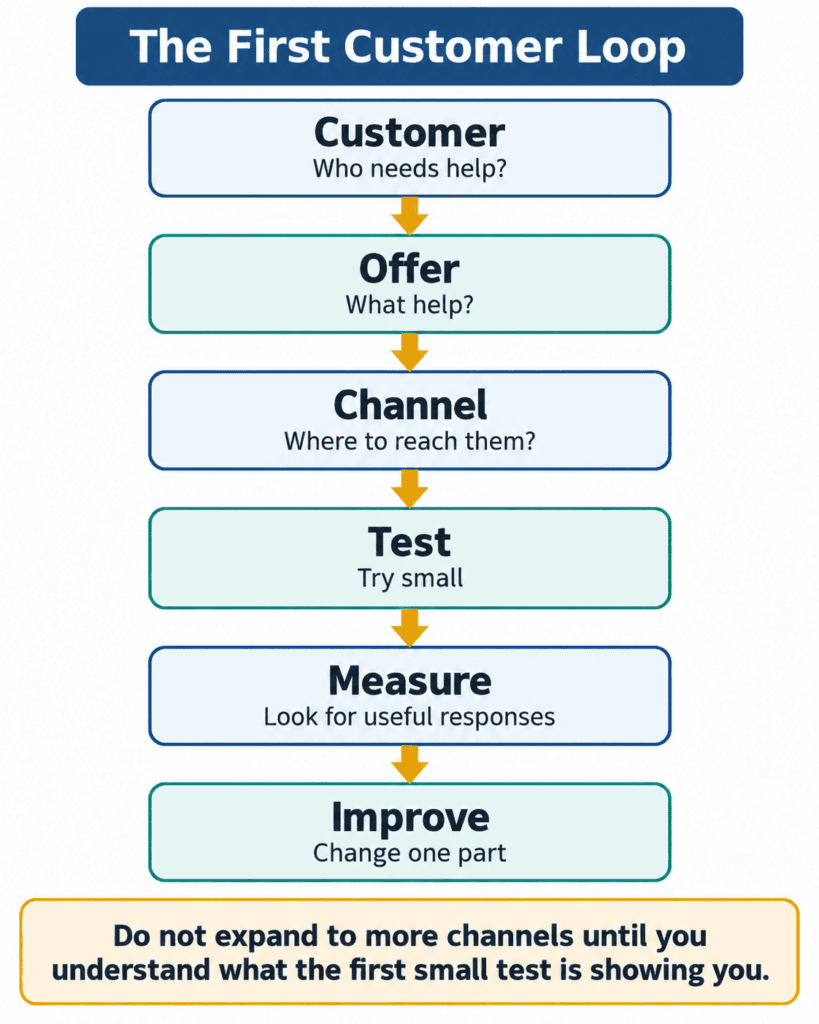
Use this loop to learn from one small test before doing more.
Measure What Matters
Marketing websites and apps can show many numbers. Some are useful.
Others can make beginners feel successful without showing whether the business is getting closer to customers.
For example, a post may receive many views without producing one inquiry.
A social media account may gain followers who never show interest in the product or service.
A website may receive visitors who leave without taking the next step.
This does not mean views, followers, or website visits are useless. They can help you see whether people are finding your message.
But they are not the final goal.
Look for responses that move people closer to becoming customers.
Inquiries
An inquiry happens when someone contacts you to ask about your product or service.
Leads
A lead is a person or business that has shown some interest in what you offer.
Qualified Leads
A qualified lead is a lead who appears to be a suitable match for the offer.
For example, someone asking about a service they actually need may be a stronger lead than someone who is only curious.
Email Signups
An email signup may matter when email is part of your customer relationship.
A signup does not mean the person will buy. It shows that the person has chosen to hear more from you.
Booked Calls
For some service businesses, a booked call may show stronger interest than a social media like or website visit.
Trial Use
Some businesses allow people to try a product or service before paying. A trial may show that the person has moved beyond simple interest.
Sales
A sale shows that someone was willing to pay for the offer. Still, one sale or one weak test does not tell you everything about the business.
Early marketing is also about learning.
Improve Before Expanding
What should you do if your first marketing test does not work well? Do not immediately add three more channels.
Look first at what may need to change.
Check the Customer
Were you trying to reach people who actually need the offer? Sometimes the problem is not the channel. The message may be reaching the wrong people.
Check the Offer
Is the offer clear? Does it solve a problem the customer understands and cares about?
If people see the message but do not respond, the offer may need work.
Check the Message
Does your message explain the help clearly? Is it focused on the customer? Is the next action easy to understand?
Check the Channel
Were you trying to reach people in a place where they are likely to look for this kind of help?
A useful offer can still struggle if it is promoted in the wrong place.
Check the Follow-Up
What happens after someone shows interest? Do you reply within a reasonable time? Is the next step clear?
Can the person easily ask a question, book a call, join the list, or buy? Sometimes the problem happens after the first response, not before it.
Improve one part at a time, then test again. That gives you useful information.
Opening more channels before you understand the first test may only create more confusion.
Continue Serving After the Sale
Marketing does not end when someone buys. A customer is a person who trusted you enough to take the next step.
What happens after the sale can affect whether that person returns, recommends you to someone else, or speaks well of your business.
Serve customers well. Provide what you promised. Communicate clearly. Answer reasonable questions and correct mistakes when needed.
A satisfied customer may return. That customer may also tell another person about the business. This is where referrals can become important.
A referral happens when someone directs another person to your business.
Not every business depends on customers buying again. But every honest business can benefit from treating customers well.
The goal is not simply to get a first sale. It is to build trust through useful service.
Useful Example 1: A Service Business
The following example is made up only to explain the process.
Suppose Maria starts an online resume-writing service.
She could try to market the business through several social media sites, paid ads, email, blogging, and videos at the same time.
Instead, she starts smaller.
Customer
She wants to help job seekers who have work experience but struggle to explain that experience clearly on a resume.
Offer
She helps them improve the wording and organization of their resumes.
Channel
She begins with helpful content in a place where job seekers are already looking for career information.
She also connects with a few people or groups that help job seekers.
Test
She shares useful information about common resume problems and gives interested people one clear way to contact her.
Measure
She watches for inquiries and suitable potential customers rather than judging the test only by likes or views.
Improve
If people read the content but no one asks about the service, she can review the offer, message, audience, or next step before adding another channel.
Maria’s first goal is not to become visible everywhere. She wants to learn where suitable customers respond.
Useful Example 2: A Digital Product Business
This example is also made up only to explain the process.
Suppose Daniel creates a simple digital product—a planner that customers can download online to help organize weekly household tasks.
His customer may behave differently from Maria’s customer.
Someone buying a low-cost digital planner may not want to book a call or have a long conversation before buying.
Daniel may decide that visual content or a marketplace where people already look for digital products is a better first test.
Customer
He focuses on adults who want a simple way to organize weekly household tasks.
Offer
The planner gives them one clear place to organize their tasks for the week.
Channel
He chooses one place where people already look for this kind of product.
Test
He uses a clear product description and shows how the planner works.
Measure
He watches product-page visits, useful questions, and sales.
Improve
If people visit the page but do not buy, he can review the product description, presentation, customer fit, or offer before paying for advertising.
The same marketing channel will not fit every business. The customer and the type of business should guide the choice.
Common Marketing Mistakes
Mistake 1: Spamming People
Spam is unwanted or excessive promotional messaging. Sending repeated sales messages to people who did not ask for them can damage trust.
What to do instead: Reach people in suitable places and give them a clear choice about whether they want more information.
Mistake 2: Posting Everywhere
A beginner may open accounts on many social media sites because it feels necessary. This can quickly become difficult to manage.
What to do instead: Choose one or two places where your customer is more likely to be. Learn how those channels work before adding more.
Mistake 3: Paying for Ads Before the Offer Is Clear
Paid advertising can bring more people to a message. It does not mean the message will make sense or that the offer will fit the customer.
What to do instead: Make the customer, offer, message, and next action clear before spending much money on advertising.
Mistake 4: Buying Tools Before You Need Them
Beginners may feel that they need special software before they can start marketing.
Some tools can be useful later, but buying several tools at the beginning can increase costs without solving the main problem.
What to do instead: First identify the task. Then decide whether a tool is truly needed to do that task better.
Mistake 5: Stopping After One Weak Test
One weak result does not always mean that the business idea or marketing channel has failed.
The customer, offer, message, timing, channel, or follow-up may need improvement.
What to do instead: Review what happened. Change one important part and test again when it makes sense.
The goal is to learn, not to expect perfection from the first attempt.
Practical Action: Write Your One-Page First-Customer Plan
You can now turn the lesson into a simple plan. You do not need complicated marketing software to do this.
Use one page of paper or a simple document.
1. Customer
Write one sentence describing the person you want to reach.
My first suitable customer is:
2. Offer
Write what problem you help solve and the useful result you provide.
I help this customer by:
3. Channel
Choose one or two places where this person is likely to look for help, learn, compare options, or buy.
I will start with:
4. Test
Write the small marketing action you will take.
My first test will be:
5. Meaningful Measure
Decide what useful response you will watch for. This might be an inquiry, signup, suitable lead, booked call, trial, or sale.
I will measure:
6. Time or Spending Limit
Set a reasonable limit for the first test.
I will give this test:
7. Improve
After the test, review what happened before adding another channel.
Ask:
- Did I reach the right people?
- Was the offer clear?
- Was the message clear?
- Was the channel suitable?
- Was the next action easy?
- Did I follow up properly?
Then decide what to improve.
A small plan like this can help you learn more than trying several marketing methods without a clear purpose.
Key Points to Remember
- Start with the customer before choosing a marketing channel.
- Make your offer clear and easy to understand.
- Choose one or two realistic channels first.
- Remember that “free” marketing can still cost time and effort.
- Run a small test before making a large commitment.
- Measure inquiries, suitable leads, signups, calls, trials, or sales when they fit your business.
- Do not judge marketing only by views or followers.
- Improve the customer, offer, message, channel, or follow-up before expanding.
- Do not buy tools simply because other businesses use them.
- Continue serving customers well after the sale.