A business idea can sound good and still fail to solve a problem that people care enough about. That is why it is wise to test the idea before you spend too much money or time building it.
You do not need perfect proof before you begin. No test can guarantee that a business will succeed. You need enough real evidence to help you make a better decision about what to do next.
Quick Answer
To validate a business idea means to gather real evidence before you spend too much money or time building the business. You may also see this called business idea validation or market validation.
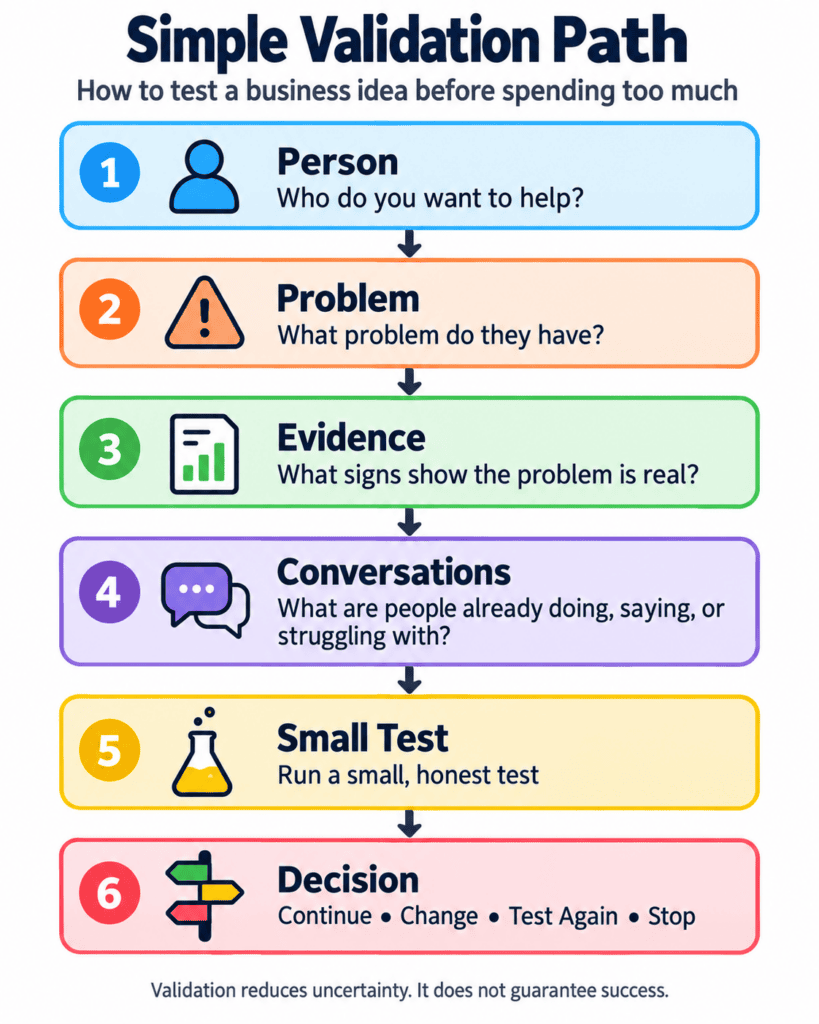
Start with the person you want to help and the problem you want to solve. Look for signs that the problem already exists. Talk with people who may have the problem, then run a small, honest test.
Pay more attention to what people do than to what they say they like. Validation reduces uncertainty. It does not guarantee that your business will succeed.
Why Validating Your Business Idea Matters
It is easy to become excited about a new business idea. You may start thinking about a business name, logo, website, equipment, software, advertising, and other expenses.
But there is a more important question to answer first: Do real people have the problem you want to solve? Do they care enough about it to take action?
Validation helps you look for that evidence before you spend a lot of money or time. It does not mean you should never spend money on a new business. It means you should try to learn before spending more than you need to.
A small test may show that your idea has promise. It may also show that something needs to change. Perhaps the problem is real, but your first solution is not right.
Either way, you have learned something useful. It is better to learn early than to spend months building something people do not want.
Start With the Person and the Problem
A business should solve a useful problem for someone. Before you test your idea, write down who you believe has the problem.
This person is sometimes called your target customer. That simply means the type of person you hope your business will serve. Try to be specific.
For example:
Too broad: People who need help with computers.
Clearer: Small local business owners who struggle to set up simple online appointment booking.
Next, describe the problem. Do not begin with what you want to sell. Begin with what the person is trying to do and what makes it difficult.
Ask yourself:
- What is this person trying to do?
- What makes it difficult?
- What are they doing now?
- Does the problem cost them time, money, effort, or frustration?
- How often does the problem happen?
This moves you away from asking only, “Do I like my idea?”
A more useful question is, “Is there a real problem here that people are already trying to solve?”
Look for Evidence That the Problem Already Exists
Once you have named the person and the problem, look for signs that the problem is real. Do not depend on only one type of evidence.
One sign can be useful, but it usually does not prove that people will become customers. Build a clearer picture from several pieces of evidence.
Look at What People Already Do
Find out how people deal with the problem now. They may:
- use another product;
- pay someone for a service;
- use a free tool;
- do the work themselves; or
- live with the problem because they have not found a good solution.
If people already spend time, effort, or money trying to solve the problem, that may show that the problem matters to them. It still does not prove that your idea will work.
You also need to learn whether your solution could be useful enough for people to consider.
Look for Repeated Complaints and Questions
Pay attention to what people complain about and the questions they ask. You may find these in online communities, customer reviews, discussion groups, comments, or ordinary conversations.
Look for patterns. One complaint may not tell you much. If different people keep describing the same difficulty, it deserves more attention.
Look at Search Interest
Search information can help you see whether people look online for a problem, product, service, or solution. But search interest does not prove that people will buy.
Someone may be curious, looking for a free answer, or comparing choices. Use search information as one piece of evidence, not the whole answer.
Look at What People Already Pay For
It can also help to see whether people already pay to solve the problem. You do not need to find a business exactly like the one you want to create.
You are trying to learn whether people think the problem is important enough to spend money, time, or effort on solving it.
Talk With People Who May Have the Problem
Online research can teach you a lot. But talking with real people can reveal things that online research may not show.
Your purpose is not to convince them that your idea is good. Your purpose is to learn what they actually experience.
Ask About What They Already Do
Questions about real past and present behavior are often more useful than questions about what someone might do later.
Instead of asking, “Would you pay for a service that solves this problem?” ask, “What did you do the last time this problem happened?”
You can also ask:
- Have you ever paid for help with this?
- What have you already tried?
- What is the hardest part of dealing with this?
- How often does this happen?
- What have you tried that did not work well?
- What do you wish were easier?
Then listen carefully. Do not spend the whole conversation explaining your idea. You may discover that the real problem is different from what you first thought.
Be Careful With “Would You Buy This?”
People often want to be polite. A friend may say, “That is a wonderful idea.” Someone may even say, “Yes, I would buy that.”
Those answers may encourage you, but they are not the same as real buying behavior. People sometimes say they like something and later take no action.
Compliments can encourage you. They should not be your strongest evidence.
Create a Small, Honest Test
After you understand the problem better, test your idea on a small scale. You do not have to build the complete business first.
The right test depends on what you plan to offer. The goal is to learn, not to make the test look successful.
Try a Small Pilot
A pilot is a small first test of a service or program. For example, you might test an online tutoring service with a few suitable learners before building a larger tutoring business.
This can help you learn what people need, what works, and what needs to improve.
Offer a Small Version of a Service
If you plan to offer a service, you may test a limited version with a few people. Be clear about what you are offering.
Do not pretend that you have a large company, a large team, or experience you do not have.
Use a Simple Landing Page
A landing page is a simple web page made for one main purpose. You might use one to explain a planned offer and see whether people ask for more information or join a waiting list.
The page must tell the truth. If the product is not available yet, say so.
Use a Real Waiting List
A waiting list can show more interest than a social media like because the person has taken an extra step. But the waiting list must be real.
Tell people what they are joining and what will happen next. Do not create a false waiting list to make your idea look popular.
Test a Prototype
A prototype is an early test version of a product. It does not need every feature that the finished product may have.
Its purpose is to help you learn whether people find the idea useful and what needs to change.
Consider a Pre-Order Only When It Is Appropriate
A pre-order means that someone agrees to buy before the finished product is ready. This can provide stronger evidence because the person is willing to commit money.
But a pre-order must be handled honestly. Be clear about:
- what the person is buying;
- what is ready and what is not;
- when you expect the product to be available; and
- any payment or refund terms that apply.
Do not create a fake product page, false shortage, fake waiting list, or another misleading test just to make the idea look successful.
The purpose of validation is to learn the truth. A dishonest test gives you bad evidence and can damage people’s trust.
Pay Attention to What People Do
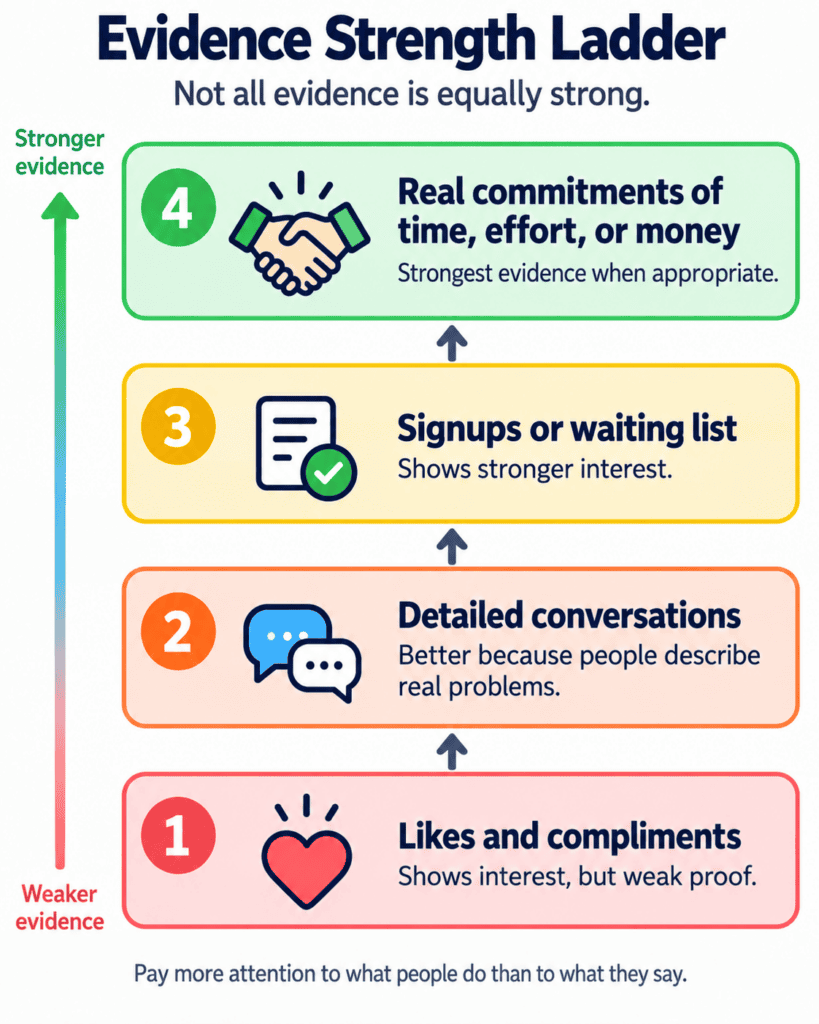
Not all evidence has the same strength. A like on social media may show interest, while a detailed conversation takes more effort.
A person who joins a real waiting list has taken another step. Trying your service, booking a call, placing an appropriate pre-order, or making a purchase may be stronger still.
This does not mean every idea must produce a sale before you continue. Different businesses need different types of testing.
Look for meaningful behavior. That means actions that show more than simple interest.
Ask:
- Did people reply?
- Did they ask serious questions?
- Did they sign up?
- Did they use the test version?
- Did they come back?
- Were they willing to spend time on the problem?
- Did anyone make a real commitment when that was appropriate?
These actions often tell you more than praise alone.
One sale does not prove that your business will succeed. The point is to judge the evidence more carefully.
Decide What the Evidence Means
After your test, do not ask only, “Did my idea work?” Ask, “What did I learn?” Then choose the next sensible step.
You have four choices: Continue, Change, Test Again, or Stop.
Continue
Continue when the evidence is promising enough to justify another sensible step. You may still need more testing.
Validation does not mean you now know everything. It means you have enough useful evidence to consider moving forward.
Change
Sometimes the problem is real, but your first solution is not right. You may need to change the offer, the type of customer, the price, or the way you provide the service.
Changing the idea does not automatically mean you failed. It may simply mean that you learned something useful.
Test Again
Sometimes the evidence is mixed. Perhaps people clearly have the problem, but your first test was too small.
Maybe they showed interest but did not take the next step. Another small test may help you understand the situation better.
Stop
Sometimes the evidence is weak enough that continuing does not make sense. Stopping can save you money and time.
You can return to an earlier business idea, change direction, or test another problem.
Your decision does not have to be complicated: Continue / Change / Test Again / Stop.
Useful Examples
Example 1: Testing a Simple Service Idea
This is a hypothetical example, not a real customer story.
Maria is thinking about offering a service that helps very small businesses create simple appointment-booking pages. She likes the idea, but she does not begin by buying expensive software.
First, she talks with several small business owners. Some already have booking systems and do not need help.
Others say their customers still use phone calls and messages because the booking process is confusing. A few owners say they tried booking tools but found the setup difficult.
Maria then offers a small test service to a few suitable businesses. She clearly explains what she will do and what the test includes.
If several businesses use the service, find it helpful, and want to continue, Maria has stronger evidence than she had at the beginning.
She still does not have a guarantee. But she now knows more than she did before.
Example 2: An Idea That Needs to Change
This is also a hypothetical example, not a real customer story.
Daniel wants to create a paid beginner gardening guide. He asks several people whether they like the idea, and most say yes.
Then he asks what they already use. He learns that most can already find enough free beginner gardening information.
Their real problem is more specific. They struggle to know what to plant in a small space and in their local climate.
Daniel now has better information. Instead of creating the general guide right away, he tests a more specific solution.
His first idea helped him start learning. The evidence then showed him where the stronger problem might be.
Common Mistakes When Validating a Business Idea
Depending Too Much on Friends and Family
Friends and family may want to encourage you. Their support can be valuable, but they may not be your customers.
They may also avoid saying something that could hurt your feelings. Instead, talk with people who actually have the problem you want to solve.
Treating Search Volume as Proof
Search volume is an estimate of how often people search for a word or phrase. It can show interest in a subject, but it cannot prove that people will buy your product or service.
Instead, combine search evidence with conversations and real tests.
Believing Every Survey “Yes”
Surveys can help you learn, but someone may say they would buy something and later behave differently.
Instead, ask about real past behavior and look for meaningful actions.
Counting Social Media Likes as Customers
A like is easy to give and usually requires very little effort. It is not the same as becoming a customer.
Look for stronger actions such as useful replies, signups, trial use, booked conversations, or suitable purchases.
Building Too Much Before Testing
A beginner may spend months building a website, buying tools, or preparing a large product.
They may do all this before learning whether people care about the problem.
Build only enough to learn what you need to know.
Trying to Make the Test Look Successful
Fake waiting lists, false shortages, misleading offers, or pretending that a product exists can make the results look better than they really are.
They can also damage trust. Keep the test honest. You need useful evidence, not impressive-looking numbers.
Practical Action: Validate One Business Idea
Choose one business idea. Do not try to validate several ideas at the same time.
Write down your answers to these questions:
- Who do I want to help?
- What problem do I believe this person has?
- What evidence shows that the problem already exists?
- What are people doing now to solve it?
- Who can I talk with about the problem?
- What can I ask about their real past or present behavior?
- What small, honest test can I run?
- What behavior will count as useful evidence?
- What did I actually learn?
- Should I Continue, Change, Test Again, or Stop?
Do not force the answer you hoped to get. Write down what the evidence actually shows.
If the evidence is promising, your next step is not to start spending freely. The next step is to work out what the business may realistically cost to start.
Key Points to Remember
- Validation means gathering evidence before you build too much.
- Start with a real person and a real problem.
- Do not depend on only one sign.
- Search interest, likes, compliments, and survey answers can help, but they are weak by themselves.
- Ask potential customers about what they already do.
- Run a small, honest test.
- Give more weight to meaningful actions than to praise.
- Validation reduces uncertainty. It does not guarantee success.
- Use the evidence to decide: Continue, Change, Test Again, or Stop.
What to Do Next
If your evidence is promising, the next useful step is to work out what it may cost to start the business. You can then separate necessary costs from expenses that can wait.
Add that link only when the page is approved, published, and genuinely useful.
If the evidence for your idea is weak, do not keep spending simply because you have already started. Return to your business choices, adjust the idea if needed, and test again.
A good validation process does not tell you what you want to hear. It helps you make your next decision with better information.