You have chosen an online business idea and are ready to make the business more formal. Now you may be wondering how to register an online business and what you actually need to do.
In the United States, there is no single registration process for every online business. What you need to do depends on your business structure, where you operate, and what your business does.
This guide will help you check the main requirements one at a time. It will also show you where to find current official information before you file a form or pay for a service.
1. Quick Answer
There is no single U.S. registration process that applies to every online business.
First, decide or confirm your business structure. Then check your state’s rules for registering the business and its name. Find out whether you need an Employer Identification Number (EIN). You may also need licenses, permits, or state and local tax registrations.
Do not assume that every business needs a Limited Liability Company (LLC). You may not need every step in this guide.
Use current federal, state, and local government sources. Complete only the requirements that apply to your business.
2. Why This Matters
Business registration can be confusing because several different requirements are often discussed together. A beginner may think they are all part of one registration process, but they are not.
For example, forming an LLC is different from getting an EIN. Registering a business name is different from getting a license or permit. State tax registration is another separate matter.
Knowing these differences can save you time and money. It can also help you avoid paying for something you do not need or missing a requirement that does apply to you.
A good way to handle the process is to check each requirement separately.
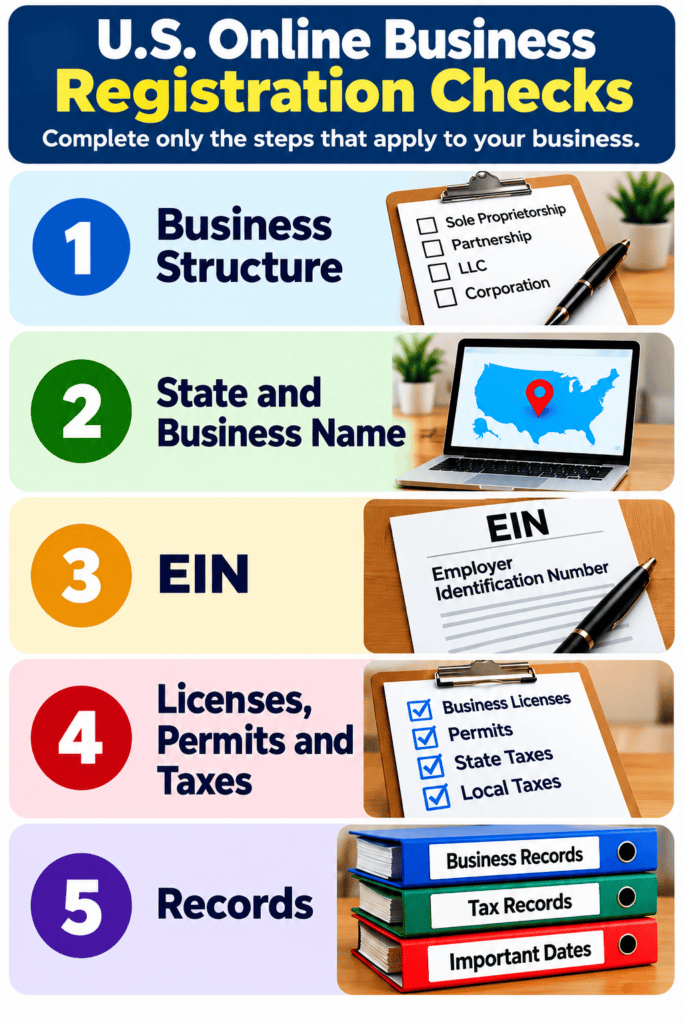
3. What “Registering a Business” Can Mean
When someone says, “I need to register my online business,” that can mean several different things. Understanding the difference makes the process much easier.
Forming or registering the business
Your business structure is the legal form of your business. Common examples include a sole proprietorship, partnership, Limited Liability Company (LLC), and corporation.
An LLC or corporation normally requires a formal filing with a state. A sole proprietorship works differently and may not require the same type of filing.
The U.S. Small Business Administration (SBA) says that how and where you register a business depends on its structure and location.
Registering a business name
You may also need to register the name you use for your business. This is different from forming the business itself.
You may see the term DBA, which means “doing business as.” Depending on the state or local area, it may also be called a trade name, assumed name, or fictitious name.
A DBA may be required when you use a business name that is different from your legal name or registered company name.
The exact rules vary by location, so check the official rules where your business operates.
Getting an EIN
An Employer Identification Number (EIN) is a federal tax identification number issued by the Internal Revenue Service (IRS).
An EIN does not form an LLC or corporation. It also does not register your business name.
Getting licenses or permits
Some businesses need a license or permit to carry out certain activities.
The requirement may come from the federal government, your state, your county, or your city.
Running a business online does not automatically remove these requirements. Licenses and permits can depend on what your business does and where it operates.
Registering for state or local taxes
Your state or local government may also require a tax registration. This is separate from getting a federal EIN.
The requirements vary by state and by type of business. Check the official tax or revenue agency for the state that applies to you.
These are different checks. Completing one does not automatically complete the others.
4. Choose or Confirm Your Business Structure Before Filing
Before you start filing forms, know which business structure you plan to use.
Common structures include sole proprietorships, partnerships, LLCs, and corporations. Your choice can affect your taxes, paperwork, legal responsibilities, and registration requirements.
This article gives general information, but it cannot tell you which structure is best for your personal situation.
One point is especially important for beginners: you do not automatically need an LLC because your business operates online.
An LLC may be useful for some business owners. Another structure may fit someone else’s needs better.
Be careful when a website makes an LLC sound like the required first step for everyone. Some companies sell formation services.
A formation service is a company that charges to help you prepare and file documents to form a business, such as an LLC. But not every online business needs an LLC or a paid formation service.
If you do not understand the legal or tax effects of a structure, consider speaking with a qualified attorney, accountant, or tax professional before you file.
5. Check Your State’s Registration and Business-Name Rules
Once you know your business structure, check the official requirements for the state that applies to your business.
The rules are not the same in every state. Depending on your structure, you may need to file business documents with a state office.
You may also need to check whether the business name you want is available.
If you operate under a different business name, a DBA or similar name registration may also apply.
Do not use another state’s rules as proof of what your state requires. Start with the official government website for the state that applies to your business.
Look for information about business formation or registration, business names, LLC or corporation filings, DBA rules, state tax registration, later reports, and renewal dates.
The SBA can help you understand the general process. For the requirement that actually applies to your business, use the responsible state or local government source.
Does every online business have to register?
Not always.
The SBA says that how and where a business needs to register depends on its structure and location.
It also notes that someone doing business under their own legal name may not need the same type of registration.
However, this does not mean that nothing else applies. A license, permit, tax registration, or local requirement may still be necessary.
That is why asking only, “Do I need to register my business?” is not enough. Check each type of requirement separately.
6. Check Whether You Need an EIN
An Employer Identification Number is a federal tax identification number for a business or other organization. The Internal Revenue Service issues EINs.
One important fact can save a beginner money: the IRS does not charge a fee for an EIN.
The IRS tells applicants to get an EIN directly from the IRS for free. It also warns people about websites that charge for one.
A private company may charge you to help with the application. That fee is for the company’s service, not for the EIN itself.
Does every online business need an EIN?
No. Whether you need one depends on your situation.
The IRS says businesses generally need an EIN for several reasons.
These include hiring employees and operating as a partnership or corporation. Some tax and business situations also require one.
If you form an LLC or corporation, the IRS currently instructs you to form the business with the state before applying for the EIN.
Use the IRS website to check whether you need an EIN rather than assuming that every online business needs one.
Where should you get an EIN?
Start with the official IRS website.
If you qualify for the online application, you can apply directly through the IRS.
Some applicants whose main place of business is outside the United States must use another IRS application method.
This is also useful for international readers to remember. An American EIN rule should not be treated as a general business-registration rule for another country.
7. Check State and Local Licenses, Permits, and Tax Registrations
Forming or registering your business does not automatically answer every license, permit, or tax question.
Requirements may depend on what you sell, the service you provide, where the business operates, whether you have employees, and whether your type of work has special rules.
State, county, and city requirements can also differ.
For example, a business that provides a service may have different requirements from a business that sells physical products.
Do not assume that online business means no local rules. The internet may be how customers find you, but the business still operates somewhere.
Check state and local taxes separately
Your federal EIN does not automatically complete your state or local tax registration.
A state may have its own tax accounts or registration steps. Whether you need them depends on the state’s rules and your business activity.
Use the official state tax or revenue website for current information.
If your business operates in several states, the questions may become more complicated, and professional advice may be useful.
8. Check the Current Beneficial Ownership Information Rule
You may find older articles saying that U.S. companies must file a Beneficial Ownership Information (BOI) report.
BOI means information about certain people who own or control a company. The rules have changed, so an older article may no longer be correct.
As of September 2026, the Financial Crimes Enforcement Network (FinCEN) says that U.S.-created companies are exempt from BOI reporting.
FinCEN’s final rule was issued on August 11, 2026, and became effective on August 14, 2026.
This is a good example of why current official sources matter. Information that was correct a short time ago may no longer be correct today.
What about a company formed outside the United States?
Some companies formed under the laws of another country are treated differently.
FinCEN says certain foreign companies that register to do business in the United States may still have BOI reporting duties.
The exact requirements depend on the company’s situation and whether an exemption applies.
If your company was formed outside the United States, check FinCEN directly. Do not assume that the exemption for U.S.-created companies also applies to you.
For readers outside the United States, the U.S. rules in this section should not be used as registration guidance for a business formed in your country.
Your country’s requirements need to be checked separately.
9. Keep Your Records and Important Dates
Registration may not end after you complete the first forms. Some requirements continue after the business begins operating.
Keep copies of the documents that apply to your business.
These may include formation or registration documents, business-name filings, EIN confirmation, licenses, permits, tax registrations, and government letters or emails.
You do not need to collect documents for requirements that do not apply to you. The goal is simply to keep the records you do need organized and easy to find.
Also record important filing and renewal dates as soon as you learn them. A simple calendar or reminder system can help you keep track of what needs to be done later.
10. Know When to Use an Official Source or Qualified Professional
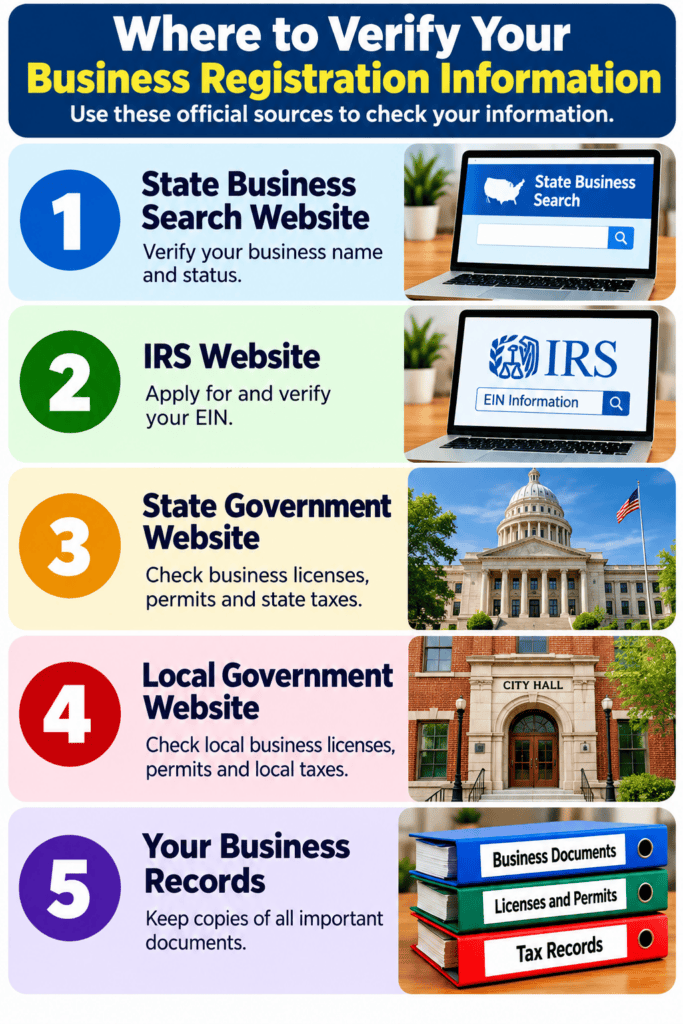
A business article can help you understand the process, but it should not replace the government agency that controls a requirement.
For U.S. businesses:
- Internal Revenue Service (IRS) – EIN information
- Financial Crimes Enforcement Network (FinCEN) – BOI rules
- State and local government websites – registration, business names, licenses, permits, and state or local taxes
- Small Business Administration (SBA) – general guidance about starting a business
For legal or tax decisions that depend on your personal situation, you may also need a qualified professional.
When professional help may be useful
You do not automatically need to pay someone to register an online business. Many beginners can complete straightforward government steps themselves.
Professional help may be useful when several people own the business, you are unsure which structure fits your situation, or you have complicated tax questions.
It may also be useful when your business has special legal rules or operates in more than one state.
You may also want help when a mistake could create serious legal or financial problems or when official instructions do not clearly answer your question.
The important question is why you are paying for help. Do not pay for a formation service just because a website makes it seem necessary.
11. Useful Examples
The following examples are only to explain the process. They are not legal advice for a particular person or state.
Example 1: A person starting a small online service
Maya plans to provide a simple online service by herself. She does not begin by assuming that she needs an LLC.
First, she decides which business structure she plans to use.
Then she checks the official business website for the state where she will register the business. She also checks whether there are any local requirements.
She also uses the IRS website to find out whether she needs an EIN.
If a license, permit, or state tax registration applies, she handles that requirement too.
The main lesson is simple: Maya checks each category and completes only the requirements that apply to her.
Example 2: A person who decides to form an LLC
Daniel has decided that an LLC fits his situation. He completes the state filing required to form it.
That filing may not complete every other business requirement.
He still checks whether he needs an EIN, a separate business-name filing, tax registration, or a local license or permit.
Daniel also keeps copies of his documents and records any future filing or renewal dates.
Example 3: A business owner finds an old BOI article
Keisha finds an older article saying that her U.S.-created company must file a BOI report.
Instead of following the old article, she checks FinCEN directly. The current 2026 rule says that U.S.-created companies are exempt from BOI reporting.
Her experience shows why a current official source matters when a rule has recently changed.
12. Common Mistakes When Registering an Online Business
Assuming every online business needs an LLC
An LLC is one type of business structure. It is not automatically required simply because a business operates online.
Before filing, learn what the main structures mean. If you need help choosing, get individual legal or tax advice.
Paying for an EIN because a website says you should
The IRS provides EINs directly for free. A private company may charge for helping with an application, but the EIN itself does not have an IRS fee.
Check the IRS first before paying anyone.
Treating every registration as the same thing
Business formation, business-name registration, EINs, licenses, permits, and tax registrations have different purposes.
Check each requirement separately and complete only the ones that apply.
Using another state’s rules
A rule from Florida, Texas, California, or another state does not automatically apply to your business.
Use the official sources for the state and local area that apply to you.
Following old BOI information
BOI rules have changed. Older articles may still tell U.S. companies to file when the current FinCEN rule says they are exempt.
Check FinCEN directly before acting.
Assuming an online business has no local requirements
Your customers may find you online, but your business still operates from a real location.
Check whether state, county, or city rules apply to your business activity.
Paying a formation company before checking what you can do yourself
A paid service can be useful for someone who wants help. However, it is not automatically necessary.
First find out what the government actually requires. Then decide whether paying for help gives you enough value.
13. Practical Action: Complete Your Official-Source Registration Check
Before you pay a company or submit a form, work through these questions.
1. What business structure will I use?
Write down your planned structure. If you do not understand its legal or tax effects, get suitable advice before filing.
2. What does my state require?
Go to the official government business website for the state that applies to you. Check the formation or registration requirements.
3. Do I need to register my business name?
Check whether a DBA, trade name, assumed name, fictitious name, or similar filing applies.
4. Do I need an EIN?
Use the IRS website to check. If you need an EIN, remember that the IRS does not charge a fee for it.
5. Do I need a license or permit?
Check the appropriate federal, state, county, and city sources for your business activity.
6. Do I need state or local tax registration?
Use the official state or local tax agency rather than relying on a general business website.
7. Have I checked the current BOI rule?
If your company was created in the United States, check FinCEN’s current guidance. As of September 2026, U.S.-created companies are exempt from BOI reporting.
8. Have I saved my records?
Keep copies of the filings, confirmations, licenses, permits, and other records that apply to you.
9. Have I recorded future dates?
Write down renewal, reporting, permit, license, and tax dates that apply to your business.
10. Is something still unclear?
Do not guess. Check with the government agency responsible for the requirement or get qualified professional help.
Once you have handled the setup requirements that apply to your business, the next step is usually to start reaching potential customers.
14. Key Points to Remember
- There is no single registration process for every U.S. online business.
- Your structure, location, and business activity affect the requirements.
- Not every online business needs an LLC.
- Business formation, business-name registration, EINs, licenses, permits, and tax registrations are different.
- The IRS does not charge a fee for an EIN.
- State and local requirements should be checked with the government agencies responsible for them.
- As of September 2026, U.S.-created companies are exempt from federal BOI reporting.
- Some companies formed outside the United States may still have BOI requirements when registered to do business in the United States.
- U.S. registration rules should not be treated as rules for another country.
- Complete only the requirements that actually apply to your business.
- When your situation is complicated, use an official source or qualified professional instead of guessing.